Why do some bees sleep in flowers?
- Yes, some bees spend the night in flowers. They are mostly male wild bees, which have no nest to go home to.
- Females sleep in their nests, and honey bee workers sleep in the hive.
- A flower works as a shelter from cold and rain, a heater at sunrise and a meeting point with females.
- Some plants take advantage: Mediterranean orchids and irises mimic a shelter to get pollinated by these sleepers.
- A bee sitting motionless on a flower early in the morning is asleep or too cold to move: let the sun warm it up.
Short answer: yes, some bees really do sleep in flowers. They are mostly males of wild, solitary species: unlike the females, they build no nest and spend the night outdoors. The flower gives them shelter, a little warmth at sunrise and a front-row seat when the females arrive to forage. So the fact going around on social media is true. It is often the pictures that come with it that are not.
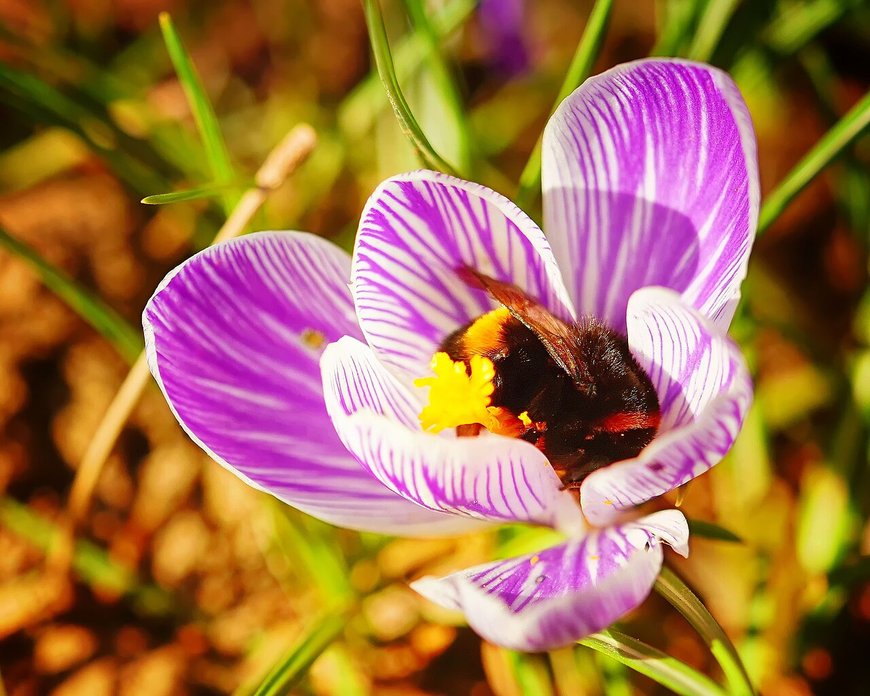
A bumblebee asleep inside a crocus. Photo : Raduvintila, CC BY 4.0, via Wikimedia Commons.
A viral photo... and a real story
You may have seen it: two bees with pollen-dusted rear ends, heads buried in a purple flower, captioned "Did you know? Bees sometimes fall asleep inside flowers when they get tired". These images keep doing the rounds on Facebook and Instagram, and many look very much like AI creations: perfect symmetry, pollen that is far too even, legs that match no real species.
The behaviour itself is very real. American nature photographer Joe Neely captured it in Arizona: looking closely at wild mallow flowers, he and his wife found a sleeping bee in almost every single one. They were globe mallow bees, specialists that share their name with the plant. In Europe, the scene is nothing new either: back in 1758, the Swedish naturalist Linnaeus named a small European bee florisomne, "the one that sleeps in flowers". And scientists have been studying this behaviour for more than forty years.
One detail in the viral caption needs fixing, though: a bee does not nod off in a flower "because it is tired", like someone dozing on the sofa. It simply spends the night there, because that is where it chose to sleep. That bees sleep is well established, and I explain it in detail in my article Do bees sleep?. The real question here is: why in a flower?
Who sleeps in flowers? Mostly homeless males
We tend to think of the honey bee, but it is just one species. Europe is home to nearly 2,000 bee species, and Britain alone has more than 250. The vast majority are solitary bees: no queen, no hive, each female digs or fits out her own small nest (in the ground, a hollow stem or dead wood) and fills it with the pollen her larvae will eat.
The male plays no part in any of this. He has no nest, no colony, no home. His short adult life, just a few weeks, comes down to drinking nectar and looking for females. So when evening falls or the weather turns, he has to find somewhere to spend the night. And the handiest place is often... the flower he is already sitting on.
It is the same story with bumblebees. Workers and the queen go back to the nest to sleep. But males, once adult, leave the colony to look for queens to mate with, and most never return. Researchers at the University of Massachusetts sum it up simply: since they do not go back, they often spend the night on flowers, sometimes in groups. Honey bee males, on the other hand, live inside the hive: I tell you about their odd fate in my article on the drone bee.
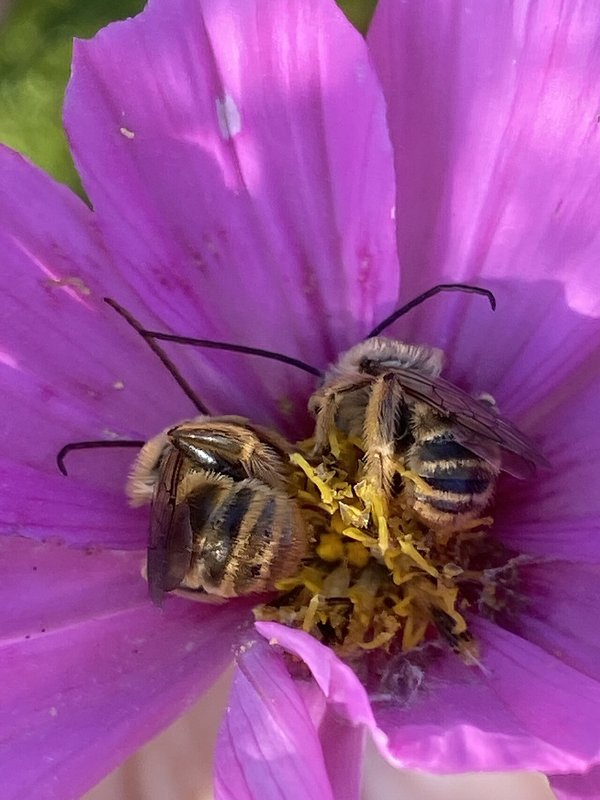
Two wild bees tucked in for the night inside a flower. Photo : Jengod, CC BY-SA 4.0, via Wikimedia Commons.
Why a flower makes such a good bed
1. A front-row seat when the females arrive
Many solitary bees are specialists: their females collect pollen from just one plant family. A male that sleeps in the right flower wakes up exactly where the females will come to forage the next morning. A Brazilian team showed this in 2017 in a study with a telling title: males somehow "know" which flowers their females prefer, and pick those to sleep in. As an entomologist at the University of Connecticut pointed out in October 2026, sleeping on the spot gives a male a head start over his rivals.
2. Shelter from cold, rain and predators
A bee cannot produce enough heat to stay active at night: as the air cools, it becomes sluggish. So it is better to be out of the wind and rain. Cup-shaped, bell-shaped or tubular flowers make excellent little huts, and some even close up over their guest in the evening. On wild irises in Lebanon, researchers saw males taking refuge at night, but also in the middle of the day whenever the weather turned cloudy or windy.
3. Free heating at sunrise
This is the most surprising part. Dark or cup-shaped flowers catch the first rays of the sun and warm up faster than the air. In the large black and purple irises of the Middle East, botanists measured flowers 2.5 °C warmer than the surrounding air after sunrise. The result: bees that had slept inside took off earlier in the morning than those that had spent the night in other shelters. In China, another team saw males of one bee species sleeping on the flowers of an alpine plant as soon as the air dropped below 18 °C, flowers that during the day were 1 to 3 °C warmer than the air.
| Who? | Where does it spend the night? | Where to see it? |
|---|---|---|
| Male long-horned bees (Eucera) | Inside the tube-shaped flowers of serapias orchids and irises | Around the Mediterranean, in spring |
| Scissor bees (small black bees) | In bellflowers, or in buttercups for the species Linnaeus named florisomne | Gardens and meadows across Europe, spring to summer |
| Male bumblebees | On or under flowers, often under the round heads of globe thistles or other thistles | Everywhere, especially in late summer |
| Male furrow bees and other solitary bees | Clustered on a dry seed head or stem, sometimes hanging on by their mandibles | Meadows, waste ground, path edges |
| Squash bees | Inside wilted squash flowers that close over them | North America, in vegetable gardens |
| Honey bee (workers and drones) | In the hive | At the beekeeper's |
When flowers cash in on sleepers: the orchid that fakes a bedroom
If bees look for a cosy hole every evening, a plant has every reason to offer one. That is exactly the strategy of the serapias, Mediterranean orchids also found in southern Europe. Each flower forms a small dark tunnel with no nectar and no pollen to collect: it is a decoy shelter.
As early as 1981, a team of botanists described the routine in Israel on Serapias vomeracea. In the late afternoon, the bees, mostly males of long-horned bees, mining bees, mason bees and Tetralonia, flit from flower to flower before choosing their room, where they stay all night. It is during these scouting visits that pollen travels from one flower to the next. Researchers call it pollination by "shelter imitation".
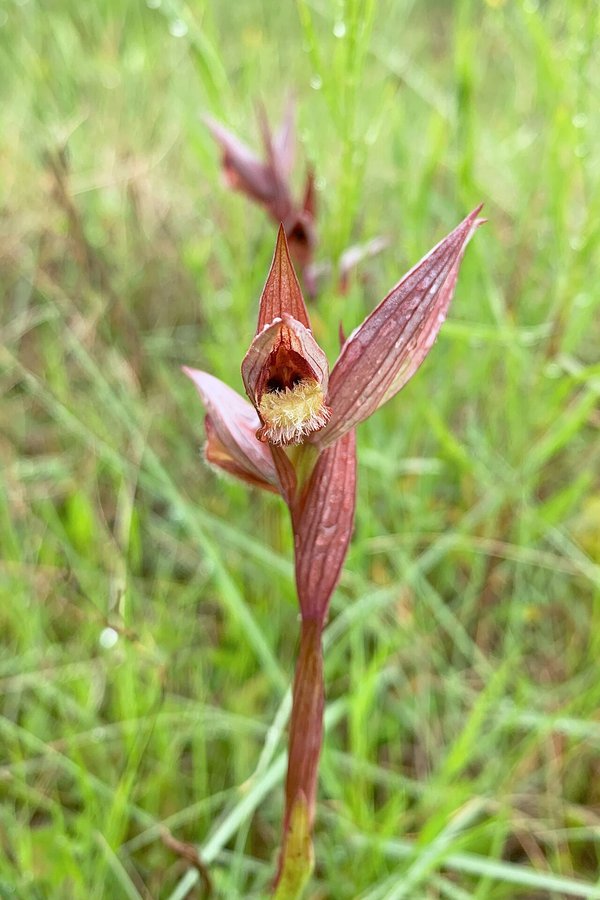
Long-lipped serapias (Serapias vomeracea): each flower forms a small dark tunnel, perfect for the night. Photo : Bouke ten Cate, CC BY 4.0, via Wikimedia Commons.
The so-called Oncocyclus irises of the Middle East take the system even further. Their flowers, the largest in the eastern Mediterranean flora, offer no nectar and hide their pollen: nobody visits them during the day. Their only pollinators are male long-horned bees that crawl inside at dusk to sleep. On average, each male checks nearly two flowers before settling in for the night, and almost 39% of the males caught in artificial flowers placed near an iris population carried pollen on their backs.
Closer to home, the small scissor bees of bellflowers practically live in their flowers: males patrol them, wait for females there, mate there and spend the night or rainy days inside. The story even inspired a European orchid, the red helleborine: a Swedish researcher showed in the journal Nature that its flowers mimic the colours of bellflowers, as bees see them, to attract those very same males.
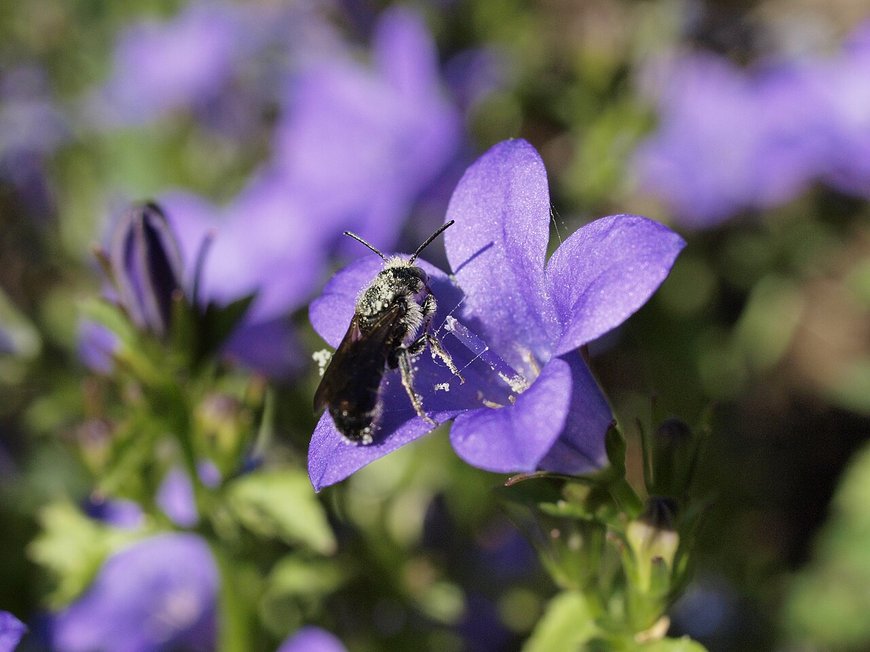
A male scissor bee (Chelostoma rapunculi) in a bellflower, its favourite flower. Photo : linsepatron, CC BY 2.0, via Wikimedia Commons.
And these males do more than sleep. In the United States, a 2011 study showed that males of a squash bee, which spend the night in wilted squash flowers, handle a large share of the pollination of courgettes and summer squash on their own. "Useless" pollinators are not so useless after all.
Sleeping by the jaws
Not every bee that sleeps outdoors picks a flower. Some prefer a stem, a twig or a faded flower, and hang on in the most surprising way: by their mandibles, their jaws. Legs folded, body sometimes sticking out horizontally into thin air, they stay perfectly still until morning.
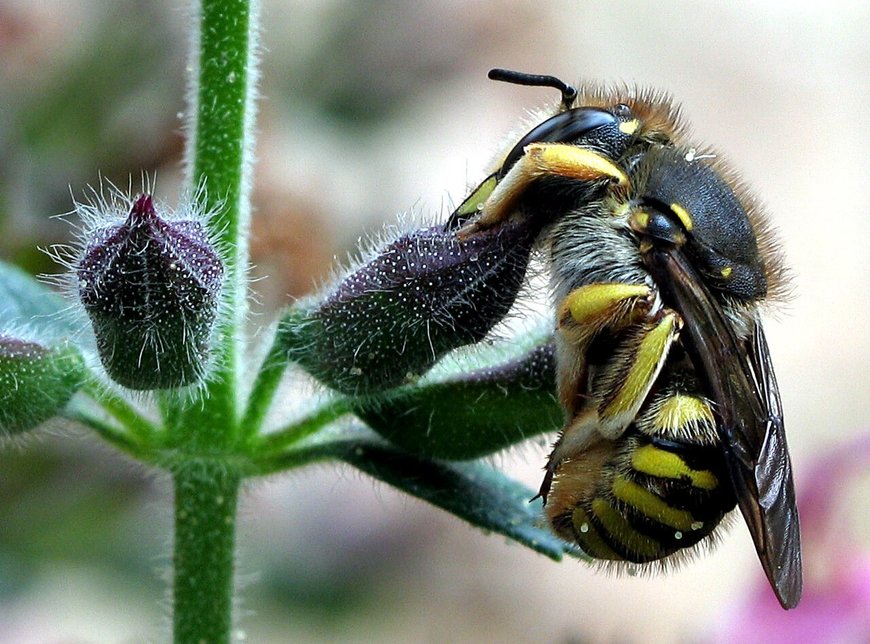
A female European wool carder bee (Anthidium manicatum) asleep, clinging to a flower bud. Photo : soebe, CC BY-SA 3.0, via Wikimedia Commons.
In the Valais region of Switzerland, naturalists followed the nights of a cuckoo bee, Biastes emarginatus: every evening, and even during the day in bad weather, they hang by their mandibles from fescue stems, 20 to 30 centimetres above the ground. German researcher Walter Kaiser, a pioneer of honey bee sleep research, compared the night-time rest of several solitary bees with that of the honey bee in 1995: he found things in common, but also real differences from one species to the next.
Other species sleep in groups. Males gather every evening on the same dry seed head or stem, packed tightly together, and often come back to the same spot night after night. These little shared dormitories are one of the loveliest sights to look out for in the garden, at dusk or very early in the morning.
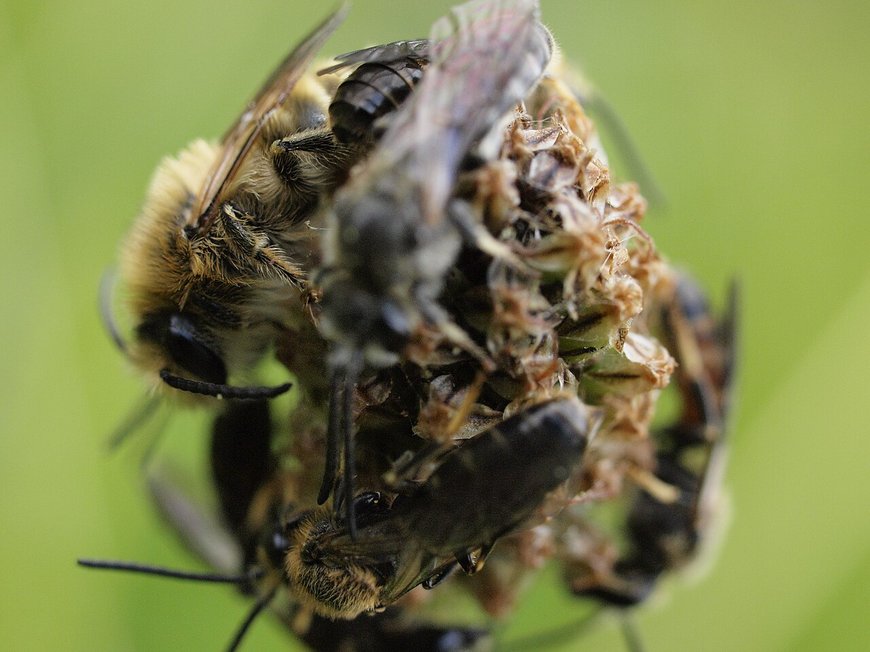
A shared dormitory: male furrow bees (Lasioglossum calceatum) clinging together to a dry seed head. Photo : linsepatron, CC BY 2.0, via Wikimedia Commons.
You find a motionless bee on a flower: what should you do?
On a cool morning, it is common to come across a bumblebee or bee that is completely still, sometimes covered in dew. Don't panic: in the vast majority of cases, it is asleep or simply waiting for the sun to warm it up. Here is what to do, based on advice from the Bumblebee Conservation Trust, the UK charity that is the go-to authority on bumblebees:
- Leave it be. A sluggish bee warms up on its own as soon as the sun comes out. Check again half an hour later: it will most likely be gone.
- If it has not moved for more than 45 minutes and there are bee-friendly flowers nearby, gently place it on one of them using a leaf or a piece of card.
- If there are no flowers around, offer it one or two drops of sugar water (half white sugar, half water) on a spoon, close to its head. Just once: it is a boost, not a meal.
- Never give honey, which can spread diseases to bees, or brown sugar, which is harder for them to digest.
Give pollinators a bedroom in your garden
Good news: hosting these sleepers takes almost no effort, mostly a little letting go.
- Plant shelter flowers: bellflowers, buttercups, crocuses for early spring, mallows, globe thistles. Plant them in clumps rather than one by one, so pollinators find them more easily and use less energy.
- Don't cut everything back in autumn: leave dry stems and faded flowers standing until spring. They serve as night-time perches, and some bees nest in hollow stems.
- Keep a corner of dead leaves and dead wood: many wild bees nest in the ground or in wood, and spend the winter there before emerging in spring.
- Add a shelter: a well-designed insect hotel rounds off these steps, especially in a small garden or on a balcony. Our wooden bee house works the same way: it mostly serves as a nest for solitary bees such as mason bees, which lay their eggs in its tubes. The males, meanwhile, will keep sleeping in your flowers!
To go further, I have gathered all the useful steps in my guide to helping bees and butterflies in your garden, and I introduce the bees' other pollinator friends in a dedicated article.
🐝 FAQ: your questions about bees sleeping in flowers
Yes. They are mostly male solitary wild bees, and male bumblebees. With no nest to go home to, they spend the night in a flower, on it or under it, or hanging from a stem. Females usually sleep in their nests.
In solitary bees, the female digs and stocks the nest: the male has none. In bumblebees, males leave the colony once adult to look for queens to mate with, and most never come back.
Normally not. Honey bee workers go back to the hive to sleep, and the males, called drones, live inside too. The sleeping bees you see in flower photos are almost always wild species.
Not necessarily. Bees cannot control their body temperature the way we do: on a cool morning, a bee stays sluggish until the sun warms it up. Most of the time it is asleep or waiting for warmth. Leave it alone and check again half an hour later.
No, never. Honey can spread diseases, and brown sugar is hard for bees to digest. If a bee or bumblebee has not moved for more than 45 minutes, first place it on a flower. If there are none nearby, offer one or two drops of sugar water (half white sugar, half water) on a spoon, just once.
Mostly bell-shaped or cup-shaped flowers, which offer good shelter: bellflowers, buttercups, crocuses, mallows, and the round heads of globe thistles, which male bumblebees shelter under. Also leave dry stems standing until spring: some bees sleep hanging from them.
Sources: Dafni, Ivri and Brantjes (1981), Acta Botanica Neerlandica; Sapir, Shmida and Ne'eman (2005), Plant Biology, and (2006), Oecologia; Monty, Saad and Mahy (2006), Canadian Journal of Botany; Pinheiro, Alves-dos-Santos and Sazima (2017), Arthropod-Plant Interactions; Cane, Sampson and Miller (2011), Environmental Entomology; Kaiser (1995), Apidologie; Nilsson (1983), Nature; observations of Biastes emarginatus in Valais, Linzer biologische Beiträge; Xishuangbanna Tropical Botanical Garden (study on Codonopsis convolvulacea); University of Massachusetts (fact sheet on male bumblebees); Bumblebee Conservation Trust; University of Connecticut (Connecticut Public, October 2026); IUCN European Red List of Bees.
Have you ever caught a bee or bumblebee asleep inside a flower early in the morning? And if these little sleepers have melted your heart, our bee plush toys have one big advantage: you can cuddle them without waking them up. 🐝
Christophe.
Share this content