The Napoleon Bee or the Imperial Bee?
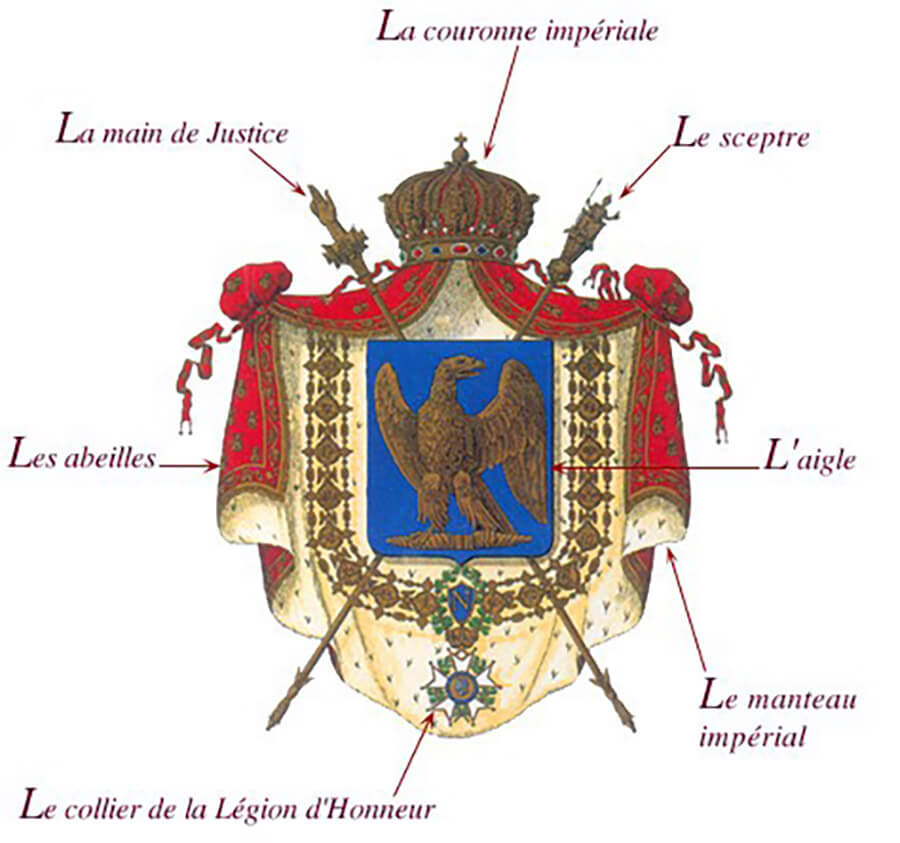
In 1804, during his coronation, Napoleon I appeared wearing a coat embroidered with approximately 1500 golden bees. This insect, along with the eagle, thus became the emblem of the Empire. It was this bee, associated with the divine, that replaced the fleur-de-lis. Some say it is considered the emblem of wise men who strive in their youth for a bright future and prosperity in their old age.
A symbol of resurrection and immortality, bees were chosen to link the modern dynasty to the origins of France. Golden bees were indeed discovered in Tournai, specifically in 1653, in the tomb of Childeric I. It is the oldest emblem of French sovereigns. The Napoleon bee therefore has several meanings. It represents obedience, hard work, and foresight. Discover this article to learn more about this imperial symbol.
The Napoleon Bee: A Symbol of the Napoleonic Empire
When he wished to definitively break with the monarchy of the old regime, the emperor received several pieces of advice regarding new symbols that would simultaneously represent his royalty and power. The Archchancellor of the Empire, Jean-Jacques Régis de Cambacérès, thus proposed bees, proclaiming that they were the image of a republic with a certain leader.
It was also a reference to Antiquity and to Virgil, who saw in the establishment of the beehive an excellent social model for the management of men. The Napoleon bees were thus present on the extraordinary purple velvet coat worn by the emperor during his coronation.
This symbol was also present on the various hangings of his palace and those of imperial administrations and courts. The bee, a majestic, royal, and sovereign insect, truly became a symbol of the industrious activity of the French and their virtues, and immediately became a famous imperial insignia.
Napoleon Bee: Divine, Royal Insect, Source of Inspiration
An emblem of the Merovingians, the oldest sovereigns of France, a treasure of adornments with golden bees was once found in the tomb of King Childeric I in 1653, Clovis's father. According to historians, they were undoubtedly part of his famous royal cloak.
If one tries to go back in time, it will be noted that bees were also a royal and divine symbol in Chaldea, having been identified following the power of the king of Lower Egypt in ancient Egypt. This represents a people who faithfully obey their king.
Rich in symbolism, the Napoleon bee has always been associated with divinity and royalty. This may be explained by the honey it produces, which some consider a pleasant, tasty, and sweet product. For others, however, it is because it conveys images of chastity, order, and eloquence. What is certain is that its interest throughout history and in symbolism has almost never wantered.
Why Do We Talk About the Napoleon Bee?
In a way, the bee established itself as a natural symbol of the places. Napoleon chose the bee as a symbol for his coats of arms and courts. Associated with resurrection and immortality, as already mentioned, it was primarily an excellent way for him to link his dynasty to the origins of the French, and then to distinguish himself from the attribute of the old regime, the fleur-de-lis.
It was thus the allegory of the Merovingian kings, the very first royal dynasty in France. Napoleon, in this sense, embroidered 1500 golden bees on his coat. During the First Empire, he imposed 3 golden bees as an image for Nice to replace the eagles of the traditional coats of arms.
The Napoleon Bee: A Symbol of Sustainable Development
From the same perspective, the Napoleon bee has today become a symbol of sustainable development and ecology. As a virtually endangered species, bees are a perfect indicator of the state of the ecosystem. It is considered that the majority of the food we eat is the indirect or direct result of pollination.
Threatened today by pesticides and certain human activities, bees are a symbol of the fight for healthy food and respect for the environment. All substances produced by the bee are very useful for the organism and sustainable development. The bee here is therefore the fruit of experience.
Ultimately, the Napoleon bee became the emblem of the empire along with the eagle. The symbolism of the bee is linked to that of honey and wax, two very important products in ancient societies. The bee is a sign of organization, intelligence, courage, patience, and hard work. It also relates to purity and sweetness. Honey was used at that time for the production of medicines and as offerings to the Gods.