Insect Hotel or Bug House?
Even though they are generally very small, insects are highly active living beings within the ecosystem. They are numerous and inhabit all spaces, even your domestic environment. Some of them are very dangerous, while others are completely harmless. To manage these creatures without constantly resorting to insecticides, you can install an insect hotel. CIt is a device that serves as a niche or shelter for various insects. If you want to know more about insect houses, this article provides you with essential information about them.
Insect Hotel: Definition and Role
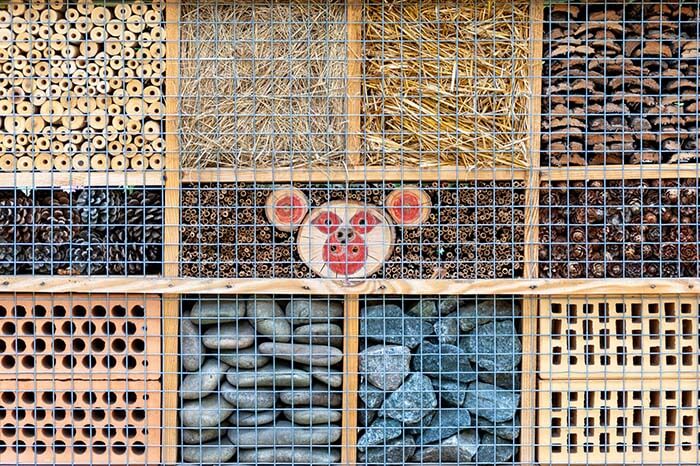
An insect hotel is a habitat built to shelter insects and other living creatures in your garden. Also known as a bug house, it is a very special wooden nesting box with several compartments, multiple levels, and chambers filled with natural materials.
Generally, these are plant materials such as leaves, flowers, stems, straw, small branches, logs, or other materials suitable for each type of insect. Each of these different chambers is designed to host a specific insect family, thereby creating biodiversity in your garden.
Having become a very common practice in recent years, some people still don't fully understand the installation of insect hotels. Most wonder why create an ecosystem for these "undesirables." In fact, bug houses attract insects that are beneficial to your various plants.
Their main role is therefore to protect all your plants, as these insects help you get rid of other parasitic insects that harm the development of your crops. These beneficial predators thus become key players in the food chain.
From an ecological standpoint, installing an insect hotel is therefore the best alternative to avoid the use of pesticides, which contain chemical compounds that are very dangerous not only for plants but also for humans.
The second function of an insect nesting box is that it hosts highly effective living beings that ensure pollination, an essential step for harvesting beautiful fruits. It also plays a role in protecting these useful insect species, which are disappearing due to human activities and lifestyles.
What Insects Can Live in an Insect Hotel?
A multitude of insects can find shelter in your nesting box. However, it's important to note that these are living beings whose cohabitation will be healthy and beneficial, as they will protect your plants against other devastating insect species.
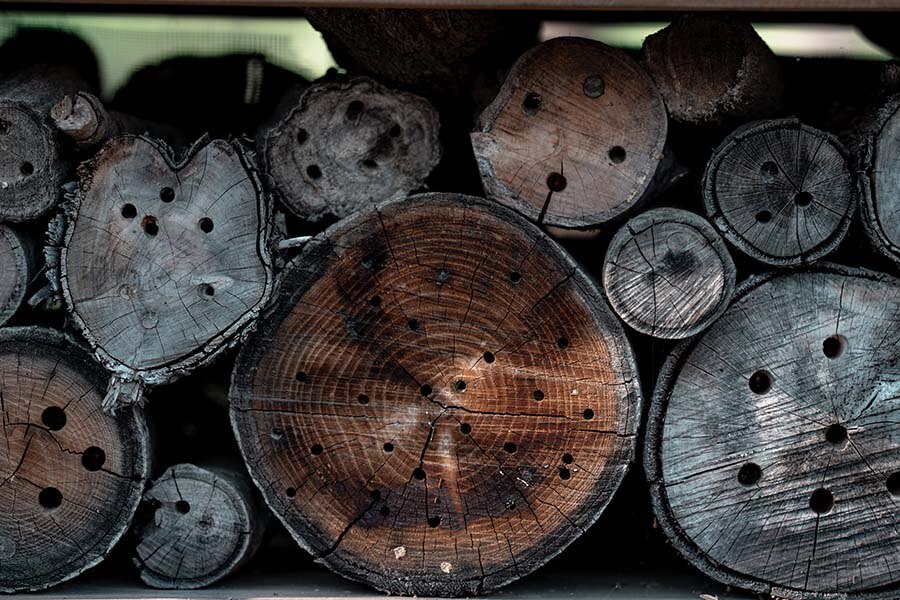
The species found in an insect hotel are attracted by the materials in the chambers. Indeed, each compartment of the house should contain different types of materials to attract as many insects as possible. For example, to attract wasps or bees, you need bricks and drilled logs.
Since these are heavy materials, they should be placed in the lower chambers of the house. These elements attract pollinating insects. To attract an earwig family, you need to install a clay pot filled with straw in the compartment.
The earwig is the enemy of aphids, so its mere presence in the vicinity will be enough to rid you of these dangerous pests. Straw can also be used to create a cozy nest for lacewings. The larvae of this insect species feed on parasites such as thrips, mealybugs, and whiteflies.
You can also assemble some bamboo stems to attract pollinating mason bees (Osmia), which are very useful for fruit trees. Similarly, rose and bamboo stems encourage the settlement of hoverflies and hymenoptera, which are true protectors of your garden.
These species are doubly beneficial in that their larvae eliminate aphids, but once adult, they also participate in the pollination of flowers.
Where and How to Properly Install Your Insect Hotel?
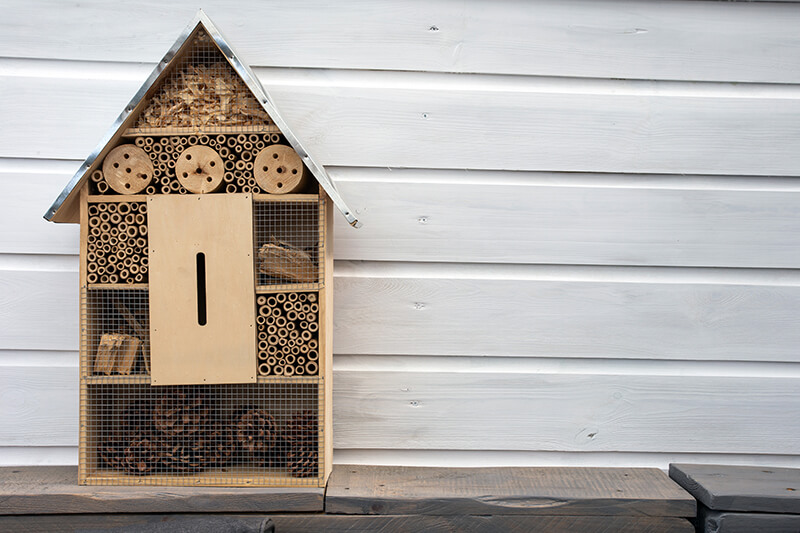
The advantage of insect hotels is that they can be placed in any green space. They adapt easily, especially since insects are generally nomadic. Nevertheless, insect nesting boxes integrate even better into so-called "wild" gardens, meaning natural, maintained spaces that respect nature.
This doesn't prevent you from installing one in your vegetable patch or garden. Moreover, in a modern living environment, the bug house is placed in the garden, as it is the space that contains the most plants. However, a specific placement is required for it to be effective and functional.
Preferably, it should be placed in a secluded and very quiet area of your garden. Additionally, the insect house should be exposed to the sun and positioned with its back to the wind. You should especially orient it towards the south or southeast side of your garden. The insect house should also be installed 30 cm (about 12 inches) off the ground to avoid contact with ground moisture.
All these technical arrangements are related to the fact that most insects are poikilothermic animals. Their body temperature depends on and varies with the temperature of their living environment.
What Are the Different Types of Insect Hotels?
The typology of insect houses is intimately linked to the types of insects they host. On one hand, we distinguish monotypic insect hotels. Their particularity is that they are designed to host only one type of insect. This kind of nesting box is much more used for insect breeding.
This is the case, for example, with osmiaculture (breeding of solitary bees), which is primarily carried out to promote pollination. There are also several other types of monotypic insect houses. In this case, the name of the species housed by the hotel (e.g., bee nesting box, ladybug house) is attributed.
On the other hand, hotels are distinguished by multiple insect species. These are the most common and promote a better ecosystem balance. They are more effective for protecting plant species against pest insects. Here, we speak of polytypic insect houses to indicate the diversity of species.
What Are the Shapes of Insect Hotels?
Today, there is a very wide variety of insect houses. The oldest form is the horizontal one, which places materials either directly on the ground or in a shallow hole. This model is practical for wild gardens, comparable to less intense forests.
You just need to gather the different elements and group them in a ground-level space. Since the surface is flat, it's clear why this is called a horizontal insect house. In contrast, we distinguish vertical insect hotels, which are the most common format. Here, the house is arranged vertically, either against a tree or freestanding.
Unlike the horizontal structure, the house is properly constructed, and the materials are arranged inside the chambers. Finally, there are modern hotels, which are optimized models of insect shelters. Even though they include natural materials, their design is completely modernized and contrasts with the concept of blending into nature.
This is the kind of insect house you can easily install in your home to add a touch of modernity. This variety is prefabricated and sold in several other forms (hanging, portable, detachable).
How to Maintain Your Insect Hotel?
The insect house is an artificial device that easily integrates into nature. It therefore easily blends in as a natural element. In this sense, the maintenance of an insect hotel is not limited. You can do it only when necessary; there is no defined periodicity.
However, maintenance varies mainly depending on the different materials used to build the house. In this sense, straw should be renewed at least every two years, pine cones at least every 5 years, and bamboo and rose stems when they are completely withered.
You should also very frequently remove spider webs that are often woven in the vicinity, as these are the main threats to insect houses. Not cleaning very often is a golden opportunity for spiders to weave webs to trap the insects in the hotel.
How to Build Your Own Insect Hotel?
If you don't want to buy one of the insect houses available on the market, it is entirely possible for you to build one yourself. The materials to use are easily accessible and often free. You can collect them in the woods, in the forest, or in an environment rich in flora.
First, you will need to set up the framework of the house by assembling wooden planks to create small chambers. Then, you just need to fill each compartment with elements collected from nature. You will also find many DIY tutorials on the subject to help you better build your insect hotel.
Don't hesitate to check out our bee hotel models. A first model: Small Beehive or Bee House AND a second model: our Bee Dormitory !