What is Beeswax?
Honey is globally renowned for its taste and benefits. However, it's not the only product of the hive. Bees also produce wax, a substance with numerous virtues.
The Composition of Beeswax
Beeswax is a hive product of a lipidic nature. Under a microscope, it's found to contain saturated hydrocarbons, pigments, acids, alcohols, etc. In total, it contains over a hundred elements. At room temperature, beeswax is solid, but at much lower temperatures, it can become brittle.
This product generally melts at 65 degrees Celsius, but it's dangerous to expose it to 120 degrees Celsius. Indeed, beyond this point, it produces flammable substances. It's also important to remember that beeswax coloration can change, especially as it ages.
Indeed, old wax adopts a brown coloration, while new wax is mostly white. However, regardless of the wax's color, this does not influence its properties.
Beeswax Production
Beeswax is produced by bees typically between one and over two weeks old. These are worker bees, and they use their wax glands for the first step. After producing wax scales, they must then mix them with salivary secretions to obtain beeswax.
A large quantity of honey is required to produce beeswax. Indeed, for 10 kilograms of wax, worker bees consume approximately 100 kilograms of honey. On the other hand, several conditions are necessary for wax production. Worker bees must be between 12 and 18 days old, and for wax-producing bees, a temperature close to 36 degrees Celsius is needed.
As for their diet, as mentioned above, it must consist of a large quantity of honey. This is why wax secretion is significant during periods of abundance and almost non-existent when food is scarce.
How is Beeswax Harvested?
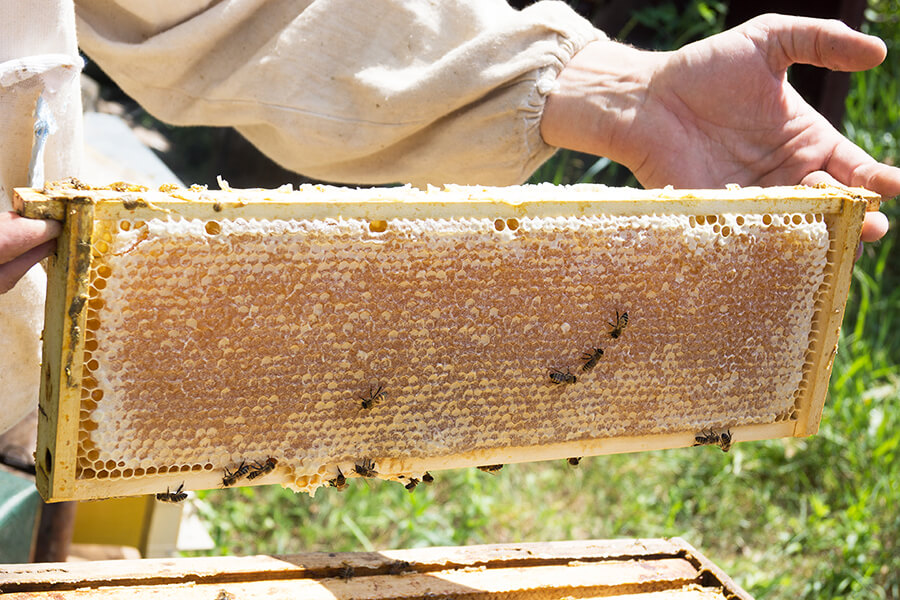
To harvest wax from inside the hive, the frames on which it is encrusted must be removed. The beekeeper then melts the wax found on the frames. To achieve this, professionals have a choice of different techniques. While some beekeepers use boiling water, others prefer a solar wax melter.
This process allows the wax to melt using the sun's heat. Another technique for harvesting wax is steam. It requires the use of two tanks, one to hold the frames and the other to collect the wax. These are not the only ways to harvest beeswax, as beekeepers can also use the centrifugation technique. These two processes still allow for the recovery of pure beeswax.
Uses of Beeswax
Inside the hive, beeswax is used in the construction of honeycombs. For humans, the oldest and most well-known use of this material is candles. However, its applications are not limited to this, as beeswax is also found in several industrial sectors.
For example, it is found in soaps, creams, and many other cosmetic products. Beeswax also plays a significant role in the food industry, modern medicine, etc.
Benefits of Beeswax
This beekeeping product is beneficial for humans in several ways. For centuries, beeswax has been used on the skin due to its healing properties. Ancient civilizations used it as an anti-inflammatory and against other skin conditions.
The exact composition of beeswax may be unknown, but its numerous properties are undoubtedly due to the many acids it contains. Furthermore, beeswax is very rich in vitamin E, making it an excellent product for anyone wishing to revitalize their hair.
This hive product is used in massage and can also aid in weight loss if skillfully combined with a diet.
If you REALLY want to enjoy the benefits of beeswax, we invite you to check out our reusable organic French beeswax food wraps. YES! REAL organic reusable food wraps, chemical-free, ECOCERT Certified.