The Solitary Bee
Bees are the primary insect pollinators of flowering plants worldwide. They are joined by other insects such as butterflies, flies, etc. The bees that carry out this pollination come in different groups. The most well-known are social bees, but there is also the group of solitary bees. Despite their significant numbers, the latter are less known.
Not only are they key players in flower pollination, but they are also true allies for gardeners. Let's take a closer look at the solitary bee.
Solitary Bees: Who Are They?
Solitary bees, unlike social bees, are less known even though they are crucial to the global bee population. For example, they account for 80% of the total bee population in France and comprise over 20,000 species worldwide. As their name suggests, they mostly live and fend for themselves.
Solitary bees very rarely move in large colonies.
However, swarms of solitary bees can form during spring. They are very discreet and often go unnoticed. Yet, they are true sentinels of the environment.
Indeed, a single solitary bee ensures 35% of the pollination of flowering plants in orchards, vegetable gardens, and ornamental gardens. Solitary bees, unlike Apis Mellifera (social bees), unfortunately do not produce honey. Therefore, there is no "booty" to save them.
Among the abundant existing species of solitary bees, the best known include the mason bee (Osmia), the carpenter bee, and the leafcutter bee.
The Mason Bee (Osmia)
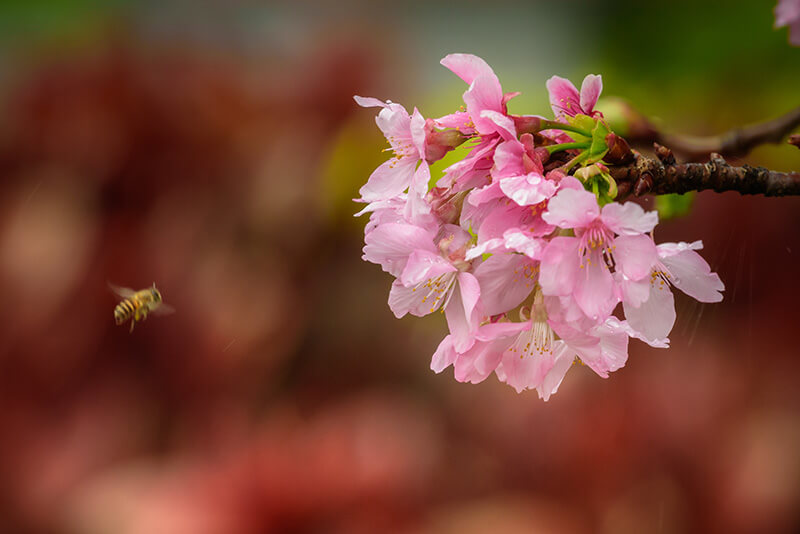
Also known as the mason bee, Osmia is one of the most common solitary bees. It is recognized by its stocky, hairy body, often reddish-orange with black stripes. It is responsible for pollinating the first fruit trees very early in the season, before social bees.
The Carpenter Bee
This bee is recognized by its massive, bluish-black body and its buzzing sound during flight. Very early in the season, the carpenter bee, like the mason bee, pollinates the first fruit trees, as well as early vegetables and ornamental shrubs.
The Leafcutter Bee
As common as the mason bee and the carpenter bee, the leafcutter bee is a regular visitor to gardens, building its nest by cutting out pieces of leaves. It is recognized by its body, which often tapers towards its anterior part, with a generally hairy brown thorax and a black-striped underside.
The leafcutter bee also plays a very important role in pollination.
What Are the Differences Between Social and Solitary Bees?
The solitary bee lives alone and does not have a colony queen, unlike its social bee counterparts. Regarding diet, adult solitary bees feed on the nectar of the flowers they pollinate. To feed her larvae, the female collects pollen with her hairs, sucks and forages for nectar, which she later mixes with the pollen. This mixture will serve to nourish the larvae.
Regarding reproduction and offspring, the solitary bee generally lays about ten eggs, which are housed individually (or in small groups) in galleries previously identified or dug for nesting.
In contrast, social bees (specifically queens) have a very particular and active metabolism. Indeed, social bee queens can produce up to 2000 eggs per day during the laying season.
Furthermore, with solitary bees, once egg-laying is complete, the bee that laid them usually dies before the larvae fully develop. This is not the case for social bee queens.
Moreover, solitary bees have a relatively short life expectancy.
They generally live less than a year and die with the arrival of winter, whereas social bee queens, summer workers, and winter workers live on average between 3 and 5 years, 5 to 6 weeks, and 5 to 6 months, respectively.
Where Do Solitary Bees Live?
To nest, the solitary bee prefers to shelter in small cavities where it can also lay its eggs. These include galleries dug in the ground or in dead wood, hollow stems of pithy plants, etc.
When there is no shelter available or when conditions no longer allow it to stay in its old nest, the solitary bee often tends to settle in window ventilation holes or in a shutter hole.
Are Solitary Bees Dangerous?
The solitary bee is completely harmless. It never stings voluntarily and only attacks when it feels truly threatened. Furthermore, its sting is benign and not painful. So, if a swarm were to form in your garden in spring, be careful; otherwise, avoid chasing them away or stepping on them. This could irritate them.
What Role Do Solitary Bees Play in the Garden?
Solitary bees are excellent garden helpers. Indeed, they ensure the pollination of flowers overlooked by social bees. Also, some particular flowers are pollinated exclusively by solitary bees.
They also pollinate these specific garden flowers in addition to those left by their social counterparts.
Thanks to the pollen collected and foraged as early as March, these insects pollinate the very first fruit tree blossoms, thus ensuring a successful next harvest. They actively contribute to the overall balance of the garden.
Attracting Solitary Bees to Your Garden: How to Do It?
Despite their many benefits, solitary bees see their natural habitats, particularly hedges and meadows, increasingly threatened. To help preserve them, an alternative is to attract them to your garden so they can nest and reproduce there.
To attract solitary bees to your garden and benefit from their advantages, consider planting melliferous flowers, shrubs with pithy or hollow stems (such as butterfly bush, weigela, hydrangea, raspberry bush, deutzia, snowberry, etc.), and fruit trees to provide them with galleries for nesting and breeding.
For example, you can plant aromatic plants, leave areas of the garden fallow for wild plants (hogweed, celandine, ground ivy, daisy, dandelion, buttercup, tansy, etc.) to grow, and build insect shelters using hollow elderberry stems, raspberry canes, etc.
Furthermore, consider spreading out blooms throughout the year to provide nectar to insects full-time. Also, avoid relying too much on highly sought-after horticultural varieties in favor of native plants, especially those with simple forms. Maintaining a sand patch in the garden to allow certain solitary bees to build their shelters there is also a very good initiative.
Finally, give a prominent place in your garden to plants such as yarrow, aster, daisy, goldenrod, and
Wallflower, lavender, campanula, sedum, fennel, mint, oregano, sage, thyme, and borage. These are highly favored by solitary bees.
However, to ensure their survival and well-being, it is imperative to stop using various insecticides and pesticides for garden maintenance. Furthermore, to protect these insect allies of the gardener, it is important to warn children not to disturb the pollinators.
Why Not Make Your Own Solitary Bee House?
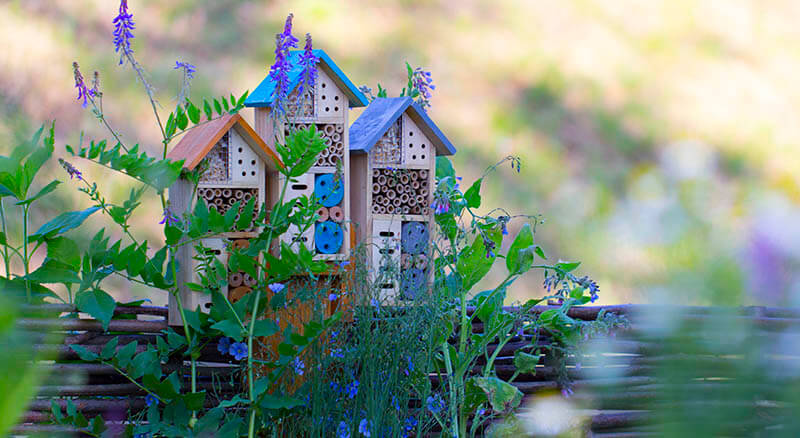
It is possible to install a solitary bee shelter in your garden. This is a shelter made of several removable trays that best replicate the diameter of the hollow stems where solitary bees lay their eggs. This type of shelter is generally made from forest wood and requires no treatment.
Alternatively, you can craft a shelter yourself as you wish. For example, using a tin can, hollow bamboo stems, and clay paste, you can create a small solitary bee hotel. If the tin can doesn't seem well-spaced, you can also use hollow bricks plugged with mortar as a nesting site.
However, if using bricks, it is important to properly prepare the mixture to be contained and dry them thoroughly before installation. For nests with hollow stems, choose appropriate wood and try to place your nest at least 50 cm from the ground.
For installing your insect hotel, do it as early as January to welcome the first bees that emerge when temperatures are around 12°C, and place the nest sheltered from all bad weather.
Furthermore, consider placing your nest in your garden, which you would have prepared to welcome bees. Finally, orient the nest towards the south or southwest so that it is sheltered from prevailing winds and faces the morning sun.