The Carpenter Bee
You've likely encountered this hairy, massive insect with a buzzing flight in your garden. Known as a xylocope, it is a carpenter bee. However, it exhibits different characteristics from the domestic bees we know. In addition to being harmless to humans, the carpenter bee does not have the same social organization as other bees.
How to Identify a Carpenter Bee?
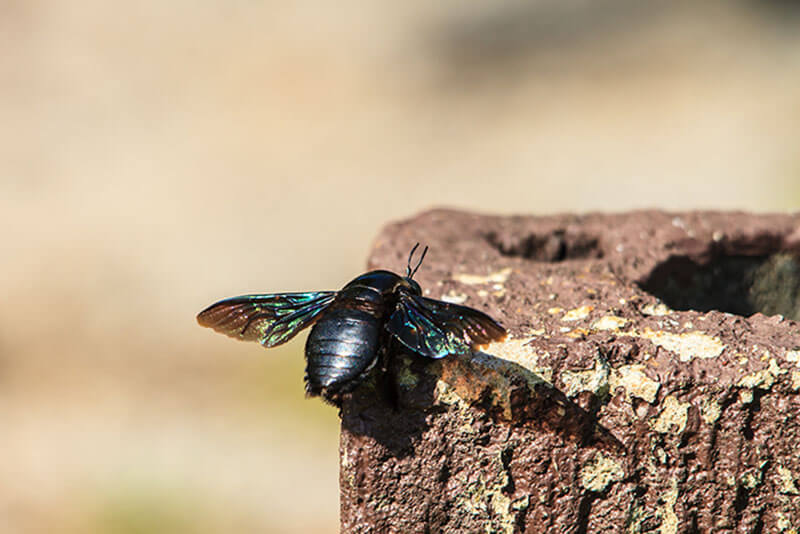
Carpenter bees do not resemble other bees. They have a distinctive appearance. They are easily recognized by their hairy and robust bodies. Very large, their wingspan sometimes reaches 55mm, with their bodies up to 30mm in length. These are massive-bodied insects whose flights are quite noisy.
Generally bluish-black in color, the carpenter bee is not organized like domestic bees at all. Unlike the latter, it does not live in colonies and has neither a queen nor workers. Therefore, it does not produce honey. The xylocope has four wings, all made of membranes.
Equipped with a large proboscis allowing it to draw pollen from flowers. Its proboscis, armed with strong mandibles, also allows it to bore into wood. Indeed, the carpenter bee, as its name suggests, is capable of digging into wood, often to establish its nest there.
Also, it poses no threat to humans as it rarely stings. It particularly favors gardens because these places contain wood. Xylocopes are very useful for gardens. Thanks to these insects, the plants and flowers in your garden will produce numerous seeds.
In fact, carpenter bees ensure the pollination of garden plants. Thus, your orchard will always be flourishing. They cause no damage to gardens, as they only seek soft wood for their nesting.
How do Carpenter Bees Nest?
Xylocope nesting is very particular. The insect only reproduces at ambient temperature when it is warm enough. Reproduction usually occurs in spring or late summer. These insects dig galleries in soft wood, elderberry stems, or old reeds.
They can also use old nests of other xylophagous insects, which they adapt for the occasion. The excavated galleries are of varying lengths. Through separations made of liquefied sawdust, these galleries are fragmented into small cells that will serve as receptacles for the eggs. The number of cells depends on the condition of the wood used by the insect.
The eggs are then deposited with pollen masses created by the female. These pollen masses feed the larva until its transformation into a pupa.
In short, the carpenter bee is an impressive insect both in its form and its organization. Quite different from its domestic bee neighbors, it does not live in groups and does not produce honey. Furthermore, it poses no danger to humans.
They are very often found in soft woods, which they dig into thanks to their powerful mandibles. These insects can also be very useful for gardens due to their pollinating role.