How to React to a Wasp Nest or Bee Swarm?
In spring, during the nesting phase of wasps or bees, these insects may enter your home and build their nest. Do you have a wasp nest or a bee swarm on your property?
Are you inclined to relocate it or get rid of it? If so, the method varies from one insect to another depending on the circumstances. Here's a guide to help you.
Identify Which Insect You Are Dealing With
First, distinguish between a bee and a wasp. Then, the difference between a wasp nest and a beehive is very important, as the approach to dealing with them differs in each case.
What Differentiates a Bee from a Wasp?
It can always be difficult to tell the difference between a bee and a wasp, especially if you're not an expert. The distinguishing features of these two insects are varied. Less hairy and stocky, the wasp has straight, smooth hairs. It has a thinner waist than a bee and displays very distinct bright yellow and black stripes.
Furthermore, the wasp's abdomen is very distinct from its thorax. The bee, on the other hand, is hairier than the wasp. It has a small coat of fuzz on its upper body that is softer and more airy than a wasp's hairs.
The bee is rounder than the wasp and has stripes that are more brownish and less yellow than those of a wasp.
Regarding diet, bees feed on flower nectar, which they pollinate, while wasps (more carnivorous) feed on meat, insects, ripe fruit, sugary foods, etc.
Also, female bees feed their larvae nectar and pollen, while wasps feed theirs with insects.
Finally, wasps are more aggressive when they feel attacked, unlike the generally harmless bee, which only leaves a mild sting.
How to Differentiate a Wasp Nest from a Bee Swarm?
A bee swarm is easier to identify. It's a cluster composed of many bees often clinging or suspended from something. The swarm is generally dark and remains motionless, with the exception of a few bees flying back and forth.
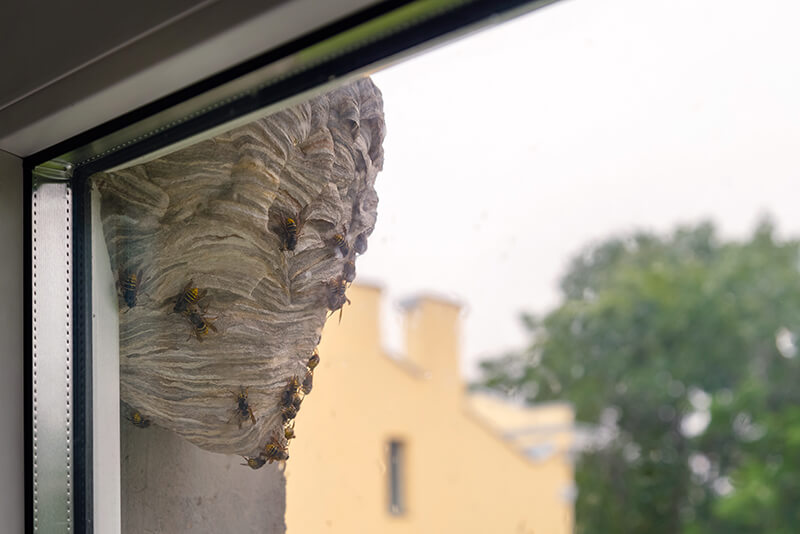
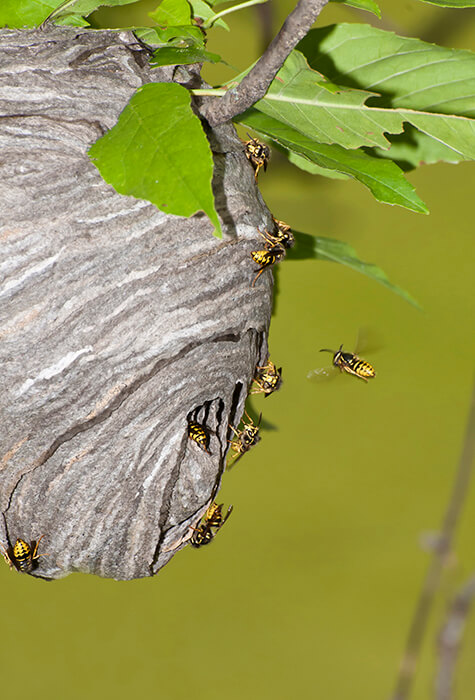
In contrast, a wasp nest is a compact mixture of chewed wood, bark, mud, and wasp saliva, forming a structure with a texture similar to newspaper. The nest is lightweight, ovoid in shape like a rugby ball, and grey in color. It features more or less wide cells.
To avoid exposure to rain, wasps generally build their nests in a sheltered corner. Furthermore, bee swarming can be due to a search for a new shelter because of a lack of space in their previous hive. Thus, the swarm can persist, and the colony may begin to build its new nest in that very spot.
A beehive is usually yellow, like the honey produced by bees. It is built from parallel wax combs. It is also suspended from something or installed in a rarely frequented corner. However, it is not common to discover a beehive.
Locating the Wasp Nest or Bee Swarm
Once you've identified the insect you're dealing with, you need to start looking for its nest. Whether it's bees or wasps, the approach is roughly the same. Bees searching for nectar for food may land on flowers in your garden. The same goes for wasps, which scavenge in your bins, attracted by the smell of sugar.
What you need to do is target one or more insects and carefully follow them as they fly. If you maintain your pursuit, you'll have a much better chance of seeing them slip into their nest.
Should you unfortunately lose track of them, you can start searching for the nest in places likely to host a wasp nest or a bee swarm/hive.
Look in areas such as the roof of a garden shed or house, attics, lofts, under frameworks, branches or hollows of trees in or near the house, window sills or frames, chimney flues, in a pile of sand or in the ground (especially for wasps), near gutters, under the mailbox, or a garden table...
Dealing with the Problem
Once the wasp nest or beehive is found, the final step is to get rid of it, especially since these insects can be dangerous when in colonies.
How to Get Rid of a Wasp Nest
Several options are available to you. You can choose between seeking professional assistance or taking matters into your own hands. However, if you plan to get rid of it yourself, make sure you are not allergic to wasps. If you are, abandon the task and call for help.
• Using Smoke to Drive Away a Wasp Colony
When you discover the nest and it's located high up, try to build a fire, proportionate to the nest's size, and place it directly underneath. Remember to wear a suit, shoes, and a respirator mask – in short, cover your entire body without leaving any exposed areas.
Also, once the smoky fire is placed beneath the nest, you can completely vacate the area and observe the wasps' movements from a distance. Once the smoke has taken effect and the wasps have completely fled, you'll need a plastic garbage bag.
With this bag, carefully approach the deserted nest and slowly cover it. Then, try to detach it and let it fall to the bottom of the bag by inverting it. Once the nest is inside, tie the bag and dispose of it in the trash.
• Exterminating Wasps with an Insecticide Spray
Here, the ideal time is in the evening, when the insects are at rest. Remember to equip yourself with an insecticide spray. This is particularly useful when dealing with wasps. Before approaching the nest, it's also crucial to cover your entire body in case a resistant wasp attacks you.
Once near the wasp nest, spray the product directly onto the nest, following the manufacturer's instructions. Then, leave the area and wait until the next day to observe the results.
If wasps are still alive, repeat the same operation the following evening and so on until the complete extermination of wasps in the nest. Finally, dispose of the remaining deserted nest. The best way would be to detach it, put it in a bag, and throw it in the trash.
• Calling a Professional
If you are allergic to wasps, or if you prefer not to attempt anything, remain calm and stay away from the wasp nest. Call a professional exterminator to solve the problem as quickly as possible. Several reasons might also motivate you to use a professional.
Among others, the wasp nest might be inaccessible or too exposed and likely to become too dangerous. Regardless of the wasp nest's location or size, professionals and specialists in insect pest control, especially for wasps, will always be able to handle the issue without exposing you to risk. Make an appointment and agree on the intervention cost.
What About a Beehive or Bee Nest?
If it's a bee swarm, don't worry too much. The colony quickly deserts the beam, trunk, or tree branch where it is suspended. Swarming bees often seek a new refuge to establish their nest. If they don't find a suitable and sheltered place for their development, they quickly leave the area.
Furthermore, when it comes to a beehive, refrain from attacking it. Not only are bees generally harmless, but they will also be beneficial if you have a garden. Indeed, they play a very important role in pollinating flowering plants and fruit trees. They are true gardener's helpers.
Also, threatened by intensive farming methods, their habitats are increasingly encroached upon. Given their essential role in biodiversity balance, bees are protected by law.
However, if the presence of a beehive bothers you, instead of destroying it (even harmless bees can be dangerous in colonies), the best solution is to call a beekeeper to come and collect the swarm or beehive. The beekeeper, whether amateur or professional, will always be willing to help you, especially as it increases their stock.
Finally, if you cannot find a beekeeper, instead of resorting to an exterminator, you can use the scent of incense or natural repellents to deter them from your home.
The best solution when facing a wasp nest is to call a professional exterminator to get rid of these potentially very dangerous insects. Regarding a bee swarm or beehive, the ideal is to preserve it or contact a local beekeeper to relocate it if you are bothered by the bees.