You have surely come across it in June, hovering in the air above a flower, striped in yellow and black. You might have had the reflex to wave it away with the back of your hand, thinking you ran into a wasp. Big mistake: this little acrobat is one of your garden's best friends... and the bees' best friend too.
- The hoverfly is a fly (diptera, 2 wings), not a wasp or a bee: it does not sting and is completely harmless.
- It mimics stinging insects thanks to Batesian mimicry, a trick to scare away its predators.
- It is the 2nd most important group of pollinators in the world, right after bees.
- Its larva is a terror for aphids: 400 to 700 aphids devoured in about ten days.
- Some species travel more than 1,000 km in migration every year.
What exactly is a hoverfly?
The hoverfly belongs to the large family of Syrphidae, within the order of diptera, meaning "true" flies. There are around 500 species recorded in France and nearly 6,000 worldwide. Despite its striped suit reminiscent of a wasp or a bee, it is indeed a fly: it has no stinger, no venom, nor the slightest intention of stinging you.
Its resemblance to stinging insects is no coincidence. It is an example of Batesian mimicry, theorized by naturalist Henry Walter Bates in 1862: a harmless species (the hoverfly) mimics the appearance of a feared species (the wasp) to deter its predators, birds first and foremost. The yellow and black suit is therefore a survival disguise... which also, unfortunately, earns it many swatter blows from misinformed gardeners.
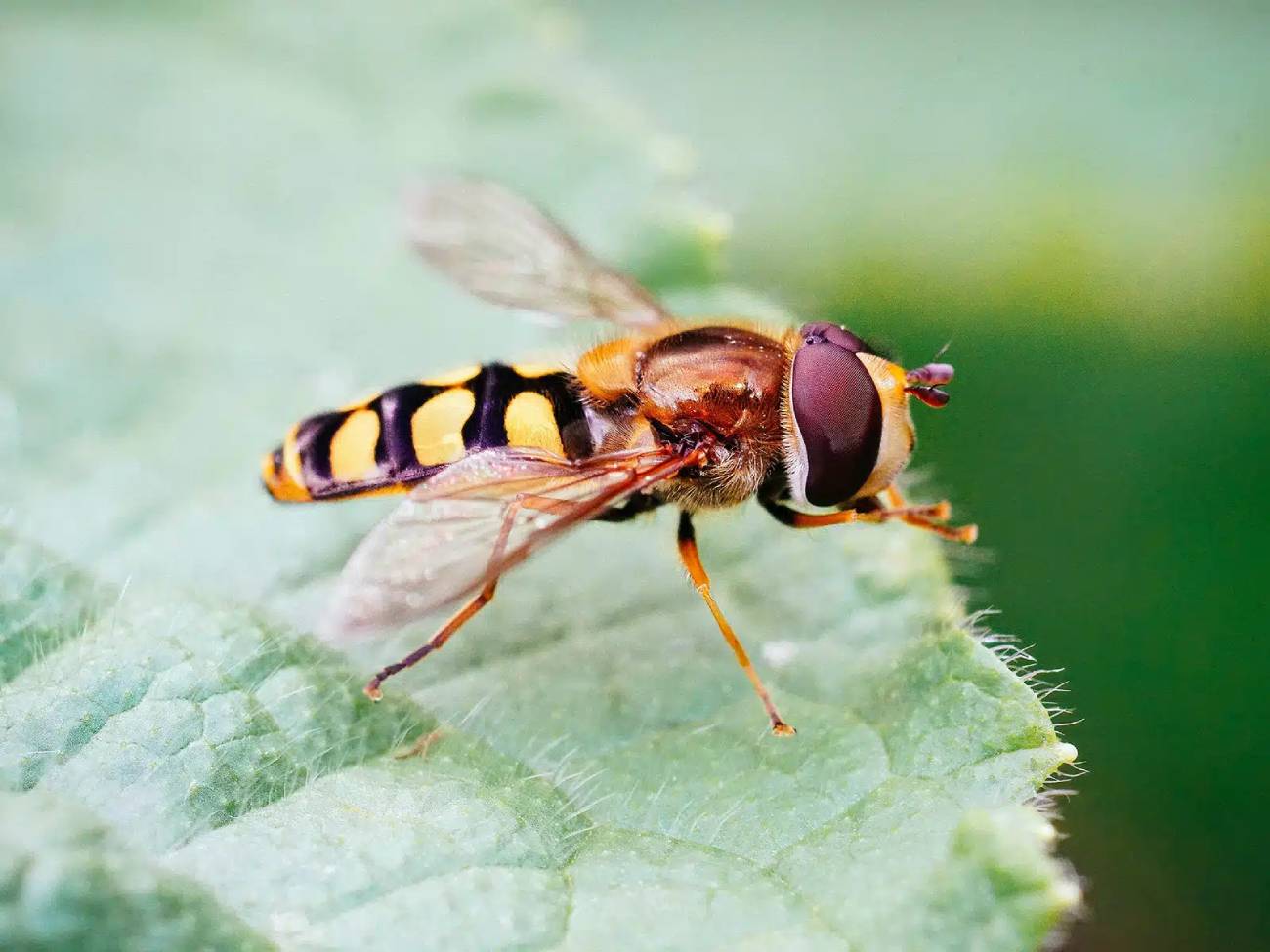
Hoverfly, wasp or bee? The differences to avoid making mistakes
Good news: once you know the right clues, identification becomes child's play. Here is how to distinguish the hoverfly for sure:
- The wings: the hoverfly only has one pair of wings (2 wings), whereas wasps and bees have two pairs (4 wings).
- The flight: the hoverfly practices hovering, standing still in the air like a mini-helicopter, before darting suddenly and then freezing again. Neither the wasp nor the bee behaves this way.
- The antennae: very short on the hoverfly, much longer on the wasp.
- The size: a small, slender body (often 8 to 12 mm), without the famous highly pronounced "wasp waist".
- The eyes: large, prominent eyes, typical of flies.
The hoverfly is one of the many pollinating friends of bees that are well worth knowing and protecting.
The marmalade hoverfly, the star of our gardens
If you only had to remember one, it would be this one: the marmalade hoverfly (Episyrphus balteatus), named for its orange hues. It is by far the most common species in our gardens, parks, and countryside, present throughout Europe, North Africa, and Asia.
It can be recognized by its abdomen adorned with double black bars on each segment, the color of which can vary from yellow to orange. Measuring 8 to 12 mm, it is one of the few insects capable of remaining active from the beginning of spring, when it is still too cool for bees, as well as at high altitudes and in areas devoid of hives.
Its larva: a formidable aphid eater
This is where the hoverfly becomes the gardener's #1 ally. While the adult feeds exclusively on nectar and pollen, the larva is carnivorous and loves aphids.
The female lays her eggs right next to an aphid colony. Upon hatching, the small, worm-like, translucent larva — which looks like a mini-slug with no visible head or legs — just has to help itself. And its appetite is colossal: according to scientific and agricultural data, a single larva devours between 400 and 700 aphids during its development of about ten days, and up to nearly 1,000 for the marmalade hoverfly. Over a life cycle, a female can lay several thousand eggs: that many little hunters released into your flowerbeds.
The result: natural aphid regulation without a single pesticide. The hoverfly acts as a perfect complement to another well-known predator, the ladybug, another great aphid devourer. Together, they form a highly effective anti-aphid brigade.
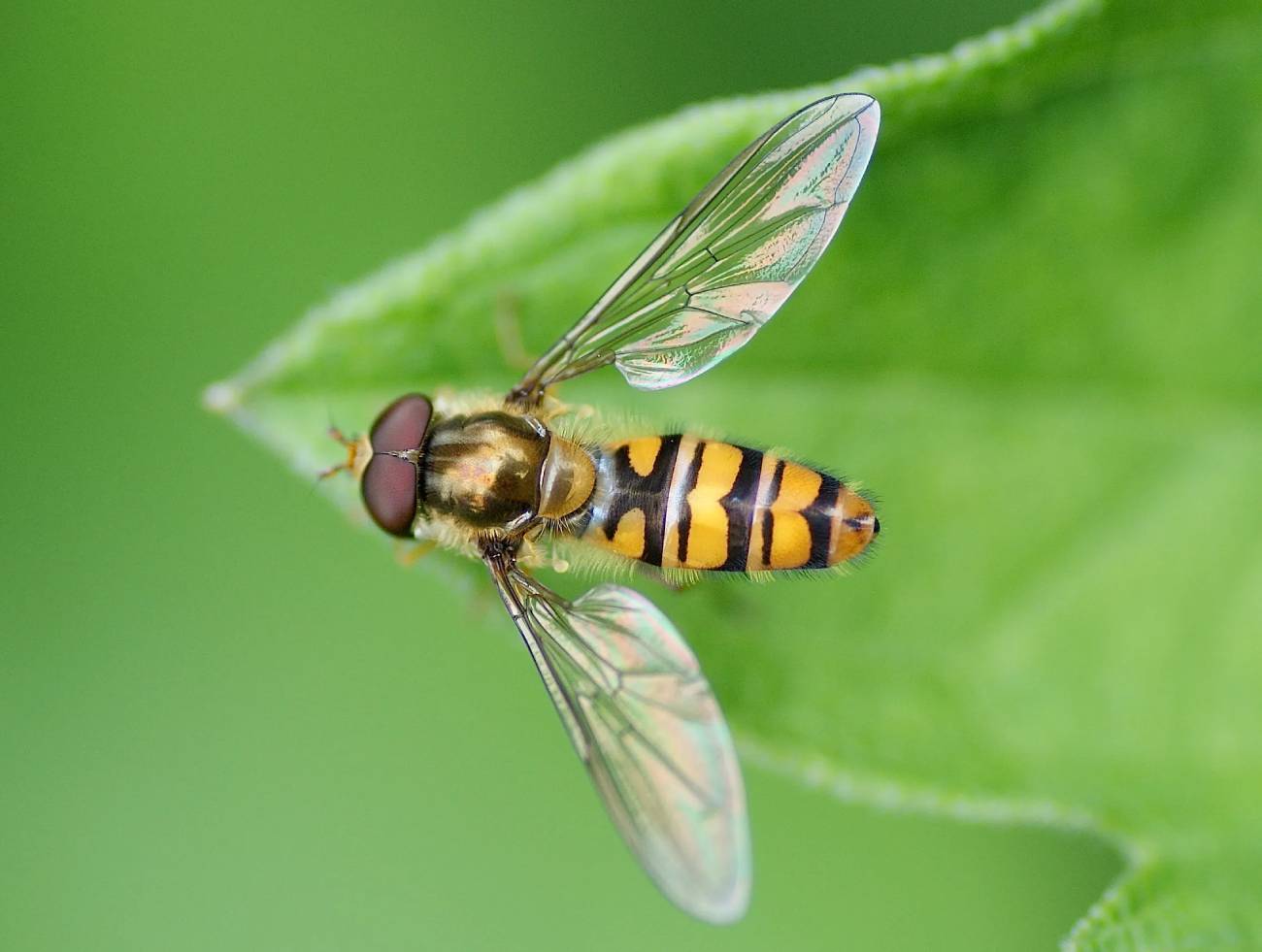
A major pollinator, right behind bees
We talk a lot about bees — and rightly so — but we often forget that hoverflies constitute the second most important group of pollinators in the world. By foraging from flower to flower to feed on nectar and pollen, the adult transports pollen grains and actively participates in plant reproduction, just like a bee.
Their asset: they remain active in cool or overcast weather, when bees prefer to stay sheltered. They thus ensure a "relay" pollination, valuable in spring and in regions where bees are scarce. The INRAE research institute also points out that diptera, and hoverflies in particular, are among the main pollinating insects alongside bees and butterflies.
The incredible journey of hoverflies: billions of invisible migrants
Here is a fact that almost nobody knows, and which makes these insects even more fascinating: hoverflies migrate, sometimes over spectacular distances.
Thanks to insect tracking radars, researchers have estimated that up to 4 billion hoverflies — or about 80 tons of biomass — cross the sky over southern Great Britain every year. Along the way, these populations consume trillions of aphids and make billions of flower visits: a massive ecological service, performed silently, high up in the sky.
The marmalade hoverfly is one of these great travelers. Scientists from the University of Exeter captured individuals mid-migration in the Pyrenees: heading south in autumn, north in spring, on journeys that can exceed 1,000 kilometers. For an insect barely 1 cm long, this is a true feat. The details of these mass migrations were notably published in the scientific journal Current Biology.
How to attract hoverflies to your garden
Good news: encouraging their presence is simple and 100% free. Here are the right habits to adopt.
1. Plant the flowers they love
Adult hoverflies have a short tongue: they prefer simple, flat flowers that are easy to access. Focus on umbellifers (wild carrot, fennel, dill), daisies, yarrows, marigolds, cosmos, borage, phacelia, ivy, lawn daisies, and poppies. A pro tip for agricultural areas: phacelia, planted along the edges, is a real magnet for hoverflies.
2. Stagger the blooms
Provide continuous flowers from March to October to offer nectar and pollen throughout their period of activity.
3. Offer them shelter
Keep a few piles of dead leaves, bundles of hollow stems, and unmown areas: these are perfect refuges for overwintering. A well-placed insect hotel ideally completes the setup, just like other accessories for a welcoming garden.
4. Ban pesticides
Anti-aphid insecticides are deadly to hoverfly larvae and harm the fertility of females. By removing them, you let your natural allies do the work for you. And tolerating a few aphids is precisely what attracts females looking to lay eggs.
Precious allies… but threatened
Like bees, hoverflies are in decline. The first European assessment conducted by the International Union for Conservation of Nature (IUCN) revealed that around 37% of the evaluated hoverfly species in Europe are threatened (vulnerable, endangered, or critically endangered). Long-term monitoring carried out in the Alps and the Pyrenees confirms a worrying collapse of migratory populations.
The causes? Pesticides, intensive agriculture that eliminates wild flowers, and the loss of habitats. By welcoming hoverflies to your garden, you are taking concrete action for biodiversity — exactly in the spirit of our commitment to the protection of bees and their pollinating friends.
FAQ — Your questions about hoverflies
No, never. The hoverfly is a fly with no stinger and no venom. Its resemblance to a wasp is merely a protective disguise: it is completely harmless to humans and animals.
Four clues: the hoverfly only has 2 wings (the wasp has 4), practices hovering, has very short antennae and a smaller body, with no marked "wasp waist".
Extremely. The adult is a major pollinator and its larva devours between 400 and 700 aphids in about ten days. It is a natural helper that advantageously replaces insecticides.
Plant simple and flat flowers (daisies, yarrows, marigolds, phacelia, umbellifers), stagger blooms from March to October, provide shelter (dead leaves, insect hotel), and ban pesticides.
No. Unlike bees, hoverflies do not produce honey, wax, or venom. They forage to feed themselves and, in doing so, pollinate flowers.
Do you see the world of pollinators differently now? The hoverfly is just one member of the great team working alongside bees for the biodiversity of our gardens. To go further, discover all the pollinating friends of bees. And if you have a question, otherwise I am here! ?
Christophe.