How to Use a Beeswax Food Wrap?
At home, we often don't finish our dishes or have to keep an unfinished preserve. To avoid food waste, throwing them in the trash, and ensure their preservation, some use food packaging such as cling film, bags, cellophane / stretch film, aluminum foil, and other single-use plastic packaging. However, these packages are not truly ecological, some are not reusable, and are not always good for health.
The Bee wrap or beeswax food wrap is both an ecological and optimal solution.
Handle and Shape the Beeswax Fabric Before Use
As part of reusable food packaging, the Bee wrap can be used to replace all plastic packaging accessories previously used for storing domestic food products. Instead of using cling film and stretch wraps, plastic storage boxes, freezer bags, aluminum foil, or trays, prefer the Bee wrap.
Ecological and durable, it is by far the best option in terms of food preservation techniques.
The sticky product on the Bee wrap allows you to shape it as you wish.
How to proceed?
The Bee wrap usually comes in cardboard packaging. You need to open the packaging and take out the batch of beeswax cloths before using them. Bee wraps are often stuck together and quite sticky to the touch.
Once the bee wraps are removed, then try to gently peel the films apart from each other. From now on, each Bee wrap can be used to wrap a product.
Using your hands, manipulate the fabric by applying slight pressure to it.
The heat produced will soften the fabric (which was rigid at first) and allow you to give it the shape you want depending on the food to be wrapped.
Simply place your food directly in the center of the reusable film and close it on itself, firmly sticking the edges / ends of the bee wrap as you would with cling film / plastic film.
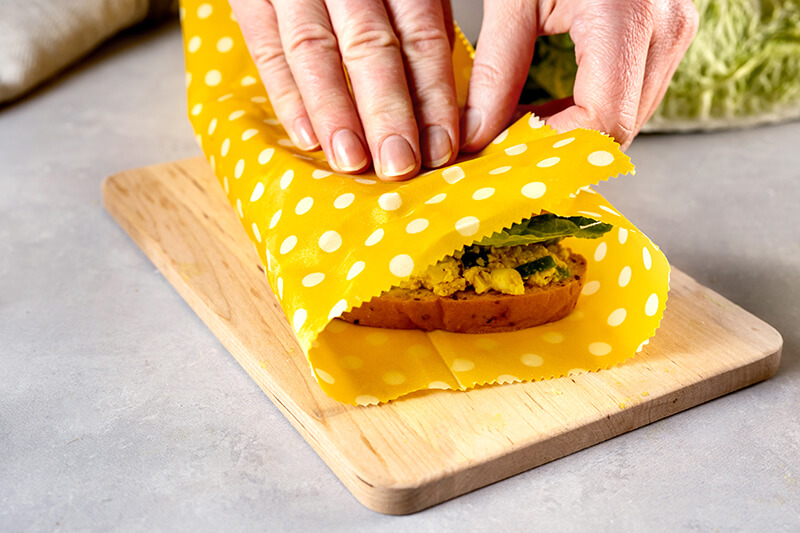
Store Almost All Food Products at Room Temperature and in the Refrigerator
The Bee wrap can be used on almost all food products at room temperature as well as in the refrigerator.
Indeed, you can use it for wrapping leftover fruits and vegetables. This could be a half-eaten avocado, an apple, a piece of cheese, or mango slices to eat a little later, just as you would with aluminum foil, except here it's more ecological with the bee wrap.
The ecological film can also be used to preserve the contents of dishes or salad bowls for as long as possible. You just have to cover them with it and firmly stick the edges of the fabric to the container.
For meal leftovers, cooked dishes, place them in a plate or a glass jar and cover the container with the Bee wrap.
You can also keep the rest of an unfinished preserve in the refrigerator by wrapping it in an appropriately sized Bee wrap.
However, for hygiene and food safety reasons, it is not recommended to directly wrap meat or fish with the Bee wrap, especially if they are raw. Indeed, these food products are likely to release blood or other liquids, which could impregnate the ecological film and compromise hygiene.
The best thing to do when it comes to storing raw meat or fish is to place them in a glass container and cover this container with the Bee wrap, making sure to avoid any direct contact between the fabric and the product.
Furthermore, wrapping hot food or any hot food product with the Bee wrap or putting it in the oven is strongly discouraged, as the heat could melt the beeswax onto the product, which is obviously not good for health. The same applies to the microwave or traditional oven; when reheating food stored in a bee wrap, you must, of course, remove the bee wrap.
Transport Your Food Using the Bee Wrap
In addition to storing domestic food products, the use of the Bee wrap extends to many situations.
As a sturdy packaging, it can be used to transport your meals and snacks or your children's snacks, everywhere.
For example, you can wrap small pastries or cookies in a Bee wrap and bring them with you to the office for snacking or to spend time with friends.
Why not wrap your sandwiches, savory cakes, or pasta salad for a 100% zero-waste picnic?
Doing bulk shopping is just as possible with the Bee wrap. Instead of disposable plastic bags or other single-use plastic packaging, the Bee wrap is perfect for carrying your fruits and vegetables and why not cheese bought from the cheesemonger?
Store Your Food Products in the Freezer Thanks to the Beeswax Fabric
Just like at room temperature and in the refrigerator, it is also possible to use the Bee wrap for storing food products in the freezer.
This is also a better tip compared to freezing with disposable plastic bags. Thus, you can wrap your breads, cakes, and brioches in the Bee wrap and put them in the freezer for several days.
Storage will always be 100% zero waste.
Even storing a whole baguette is possible. Find the ideal Bee wrap or the right trick and you're all set. However, after freezing, if you finally want to use the frozen product, it is preferable to expose both the Bee wrap and its contents to the open air for the reusable film to thaw.
All in all, the Bee wrap is ideal for packaging and storing food products. It can be used at room temperature, in the refrigerator, and in the freezer, and on almost all food products.
To avoid compromising hygiene, placing products such as raw meat and fish in a glass plate and covering it with the Bee wrap is more recommended.
Finally, it is not recommended to wrap hot products with the Bee wrap for fear of altering the product's quality with the beeswax from the fabric, as mentioned above.
Ready for eco-friendly packaging, an ecological, recyclable wrap for your food items, to put in the fridge or take with you?
Discover our 100% French, Certified Organic Bee wrap or beeswax food wrap!