How Many Bees Are There in the World?
Small insects that greatly contribute to the proper functioning of the ecosystem, bees are more than just useful. Belonging to the large Apoidea family, they are found across almost the entire globe. Domesticated by humans for many years, bees are the primary producers of honey, an essential ingredient in various fields like health, cooking, cosmetics, and more. But did you know there isn't just one bee species? In fact, several can be found on this planet.
Different Bee Species Around the World
Over 20,000 bee species can be identified worldwide. In Europe alone, there are 5 very common bee species in beekeeping.
These include:
The European Dark Bee
Scientifically known as Apis Mellifera Mellifera, the European Dark Bee is a species originating from Western Europe, specifically France. It gets its name from its black color. This hardy bee is very popular among beekeepers for its excellent ability to collect and store pollen from various flowers, and to produce high-quality honey.
The Italian Bee
This bee breed is known for its very gentle temperament and efficient work ethic. It is, in fact, the most popular species worldwide and thrives in European hives. The Italian bee is notable for its endurance and remarkable adaptability to various climates.
The Carniolan Bee (Austrian)
This bee is also known as the Carniolan bee. It is a breed originating from southern Austria, predominantly found in urban areas rather than the countryside. Gray in color, this bee species is often crossbred with the Italian bee for improved life expectancy. It is particularly well-suited for producing fir honey.
The Russian Bee (Caucasian)
This small Caucasian bee also has a grayish appearance. However, you can clearly distinguish it from the Carniolan bee by its hairiness, as this species is very fuzzy. These worker bees have been renowned since the 1970s for producing delicious honeys. They are adept at foraging deep flowers such as acacia or alfalfa.
The Buckfast Bee (Hybrid)
This fifth type of bee is also known as the Buckfast bee. It is a hybrid bee, resulting from a cross-breeding process between several bee races. This concept originated with Brother Adam, a Benedictine monk from Buckfast Abbey in England, after his bee stock was decimated by an acarine disease epidemic. Consequently, it is a popular species, highly resistant to diseases, and boasts a significantly improved lifespan compared to traditional bees.
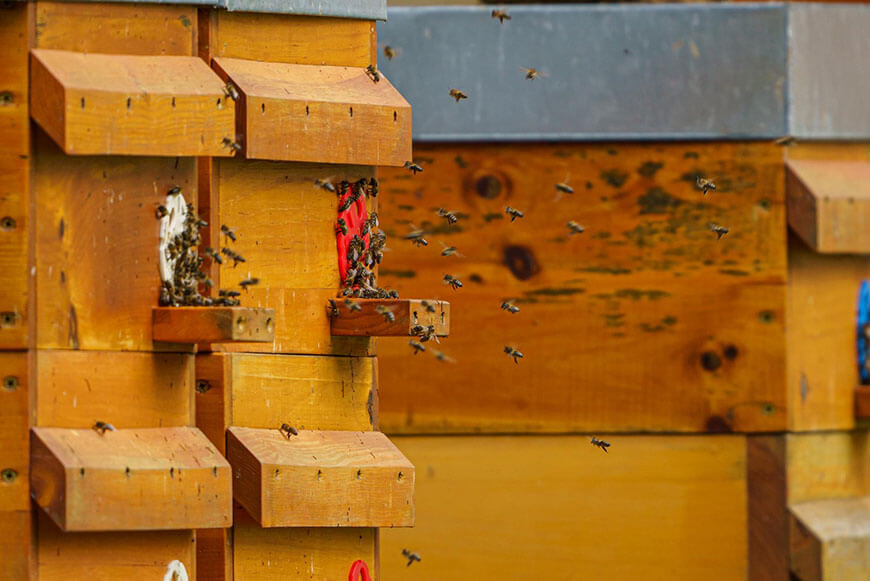
Average Bee Population per Hive
To estimate the approximate number of bees worldwide, let's first consider the average bee population within a single hive. This number depends on several parameters, including:
The Season
During spring and summer, bee populations in hives reach their peak. These are the prime foraging and honey production seasons. A single hive can then contain an average of 40,000 to 80,000 individuals.
In winter, a less productive period, this number decreases to between 15,000 and 20,000 bees per colony. Some bees leave the hive to form new colonies in more favorable locations.
The Size of the Hive
The number of bees in a hive can also depend on its size. Generally, the larger the hive, the more bees it can accommodate within the colony.
For an average hive, for example, it typically won't contain more than 40,000 worker bees, including approximately 15,000 to 20,000 nurse bees, 8,000 to 10,000 indoor worker bees, and about 10,000 to 15,000 foragers.
Based on these average bee populations per hive, we can roughly estimate the global number of individual bees! According to 2016 and 2017 statistics, the number of organic European hives reached 871,000, and in 2018, there was a slight increase to over 941,000 hives. This already accounts for several million bees, even when considering migrations.
Causes of Global Bee Decline
It is clear that despite their seemingly high numbers, the global bee population has been plummeting over the last decade. Bees now face various threats that can lead to the collapse of numerous bee colonies.
In 2006, scientists in the United States observed an alarming trend: more and more bees were abandoning their hives without apparent reason. Beekeepers were left with empty hives, entire bee colonies vanishing overnight. Research pointed to Colony Collapse Disorder (CCD), a condition that affected many bee populations in the USA for several years. In a very short period, the global bee population was significantly reduced!
Bees: Essential Pollinators for Human and Plant Survival
More than just producers of delicious honey with numerous benefits, bees are truly indispensable insects for the survival of humans and plants. They are notably responsible for pollinating 90% of fruit trees. A world without bees would therefore be a world without food diversity, and humanity would be deprived of countless resources.
In conclusion, it is therefore crucial to consistently preserve bee populations worldwide. At the very least, we must maintain a healthy average of these natural pollinators to ensure the reproduction of flora, and the stability and health of human life daily!