Do you know how many bees die per day?
The decline of bees is a real threat to humanity. It is clear that the current situation is extremely worrying as the number of bees is decreasing significantly year after year. Several studies have been put forward regarding the main causes of the indirect elimination of these natural pollinators. The consequences, however, can be fatal.
Which bee species are the most vulnerable?
With a multitude of bee species worldwide, they can be classified into two main families. On one side, there are varieties of domestic bees, which also come in several species. And on the other side, there are wild bees or solitary bees like Osmia, bumblebees, etc.
Given studies related to the decrease in bee numbers, several factors have been raised, such as diseases, Asian hornets, the greenhouse effect, and pesticides. The latter seem to particularly affect the vulnerability of certain species compared to others.
Solitary bees, such as Osmia, appear to be the most affected by the toxicity of pesticides used in cultivated fields. These varieties of wild pollinators are more vulnerable because their enzymes do not allow them to mitigate certain types of pesticides. Domestic bees, on the other hand, are more resistant as they have undergone rigorous testing concerning pesticides.
Why are bees dying?
Bee super-mortality is more alarming than ever. Apart from natural reasons, there is a multitude of causes that make bees fall like common flies. We have already listed many reasons above, such as: the existence of mites and parasites, monoculture, the use of fungicides and insecticides, pollution and human activities, attacks by Asian hornets, etc.
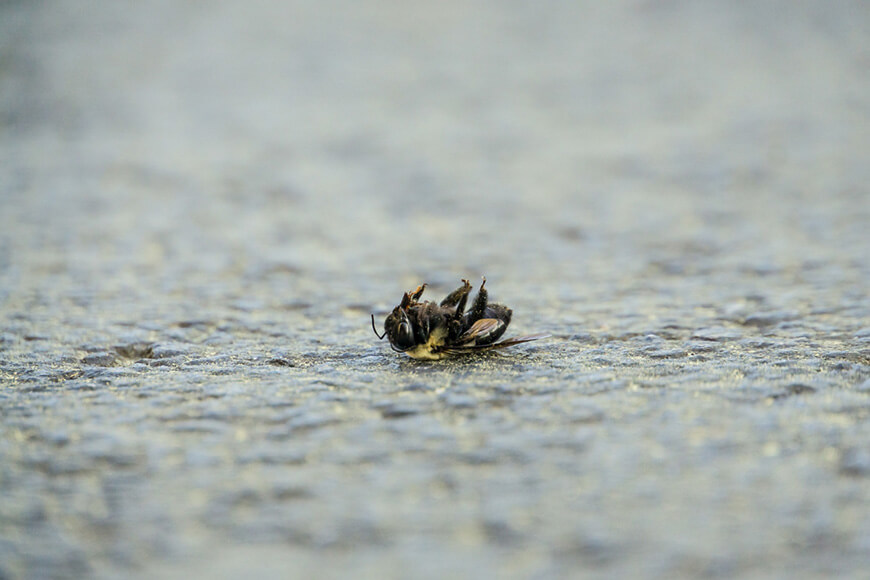
Broadly speaking, these natural pollinators die due to various processes. Naturally, a bee has a lifespan of 30 days maximum. Due to overexploitation, some do not reach this number of days. They quickly become exhausted, lacking strength and food.
However, there are more serious cases:
• Suffocation by pesticides is also a great danger for these small insects. Chemical and toxic products attack their nervous system to the point of completely disorienting them.
• Furthermore, the mundane pursuit of profit from human activities also bears its share of responsibility. Thousands of examples include: large-scale overproduction of a single crop variety. Lack of biodiversity also causes the death of certain species. The same applies to the constant transport of hives for forced crop pollination from one field to another.
• Technological advancement is also more than dangerous for these creatures. We refer to 5G networks in this case. Bees are ultra-sensitive to electromagnetic waves emitted by telephone and internet networks.
• Finally, come their fiercest predators: Asian hornets. After the introduction of Asian hornets into French territory, bees face serious problems as if humans were not enough to gradually eliminate them. These insects, originally from Asia, are merciless towards hive workers. They kill them to the point of destroying an entire lineage in a hive. This partially causes the death of a bee hive.
There are indeed other deadly factors for bees despite some people's ignorance. But parasites are also scrutinized as contributing to the demise of bees.
Winter: Is it a dangerous season for bees?
Like some animal species, bees generally survive well during winter. However, this time of year can be fatal for these natural pollinators. These insects are not hibernating. They are trying to survive against the risks of food shortages. In this case, it is hunger that can probably cause their death despite the instinctive slowing of their metabolisms.
Physiologically, bees sustain themselves with the amount of fat bodies in their abdomen. In fact, winter bees accumulate a certain amount of fat to survive. However, some natural pollinators suffer from malnutrition from the larval stage. In this case, they cannot survive during the 6 cold months.
Other cases can also arise, such as parasitic attacks. The most well-known is the Varroa parasite. This species of mite-parasite feeds on the fat body contained in bees. Even if the hive is full of ample food to last through winter, the bees may not survive this type of disease.
An estimate: the daily bee mortality rate
With an annual mortality rate of 30%, thousands of bees, or even more, die every day. Some die naturally, especially during the flowering season. Bees produce and tire themselves out more than one might think: honey, plant pollination, etc. But there are also cases of natural or genetic diseases. Also, facing a loss of more than 50% of bees during winter, the vitality of bees is very alarming.
The problems associated with this great loss are detrimental to human survival and biodiversity. More than 90% of fruit trees, food crops, etc., depend on pollination by both wild and domestic bees.