ALL you need to know about the bee development cycle!
Particularly known for their extraordinary production of honey, bees are among the insects that captivate the most attention. Their hard work and diligence remain as fascinating as ever, as they not only adapt but also appear quite vigorous. This leads us to ask many questions about their conception, development, and even their growth. All of this can be effectively summarized as the bee development cycle.
Explore the bee's journey through its development cycle in this guide.
What are Bees?
Bees are flying insects belonging to the Apidae family. They are insects that collect nectar and pollen. There are several types, and we can even count up to 20,000 species, each more distinct than the last.
Some species specialize in honey production, while others do not produce any at all. Similarly, some bee species sting, while others are not offensive at all.
What are the Stages of Bee Development?
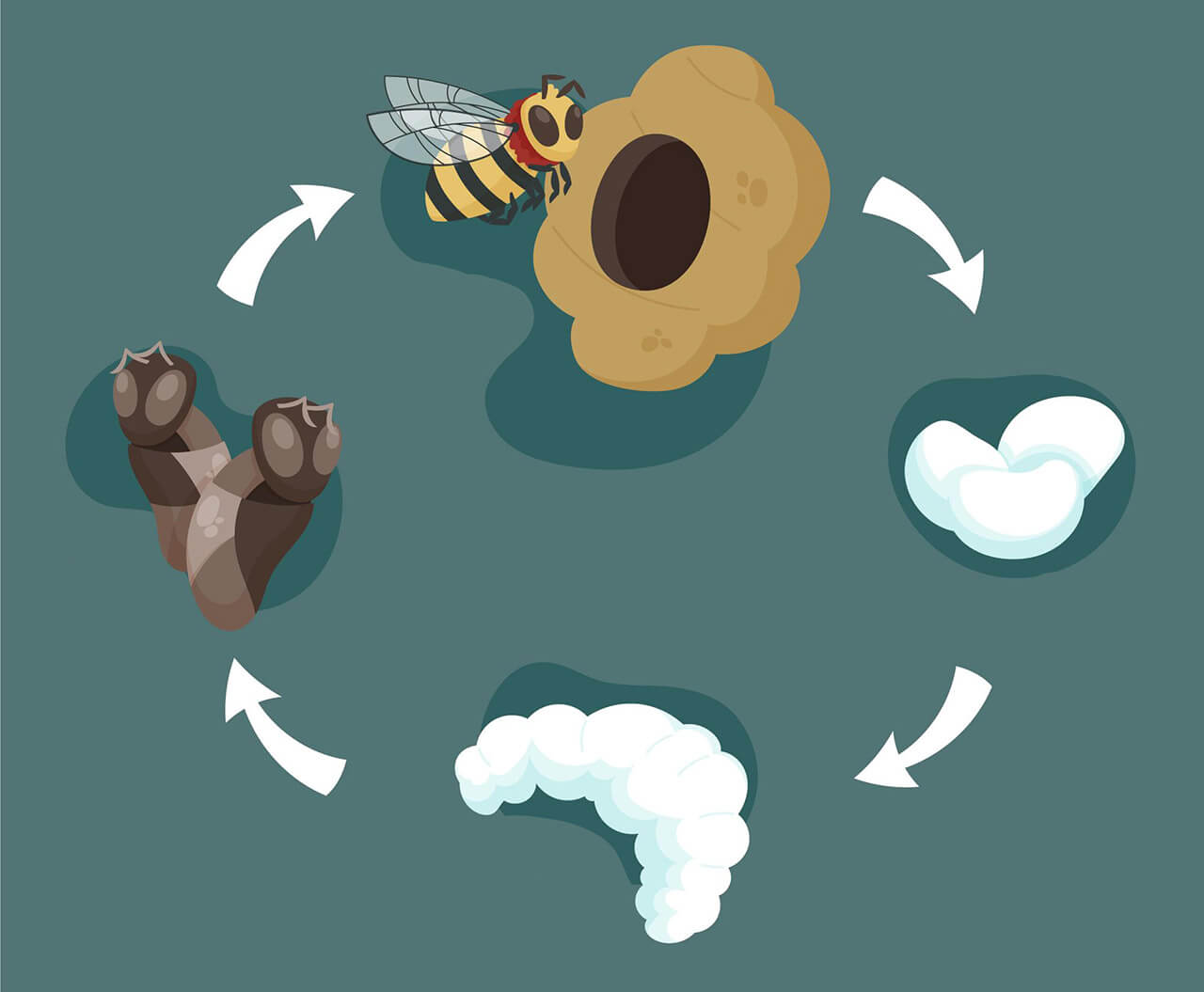
When we consider bees in their entirety, each one evolves in a rather special way. Generally, bees have a life cycle that goes through 4 main stages. Just like a child's growth, bee growth begins with the egg stage.
This stage is followed by the formation of the larva, then the pupa stage, and concludes with the imago. It's important to note that the number of days per stage varies depending on the type of bee.
The Egg Stage
As with ants, the queen bee is the one who literally lays all the eggs. Thus, if she lays a fertilized egg, it will give birth to a worker bee. It can also give birth to a queen, depending on the circumstances. However, if the egg laid is not fertilized, we will witness the birth of a drone.
It's important to know that bee eggs are white and have a cylindrical, elongated, and slightly curved appearance. This is why, at the time of laying, the queen ensures to attach the egg by one end to the bottom of the cell. Thus, the egg appears to stand upright within the cell.
Thus, for 3 days, regardless of the type of bee the egg will give birth to, we observe its progressive development. It gently tilts and eventually lies down at the bottom of the cell. Whether the future bee is a worker, a queen, or a drone, the egg spends approximately 3 days at this stage before hatching.
Thus, by the 3rd day, the egg easily hatches, doing so by dissolving its membrane. It then becomes a larva, marking the beginning of the larval stage. Generally, a bee egg measures between 1.3 and 1.8 mm long. It is also approximately 0.5 mm wide and weighs between 0.12 and 0.22 mg.
Its development time, size, weight, and many other criteria depend on the bee's race, its lineage, and even the climatic living conditions.
The Larval Stage
When we speak of a larva, it is a small worm largely composed of a digestive tube. This larva spends most of its time eating food deposited in its cell. Nurse bees are responsible for feeding the eggs until they mature.
It's important to know that a larva is even capable of turning itself around if the food offered to it is not immediately next to its mouth. Also, as a larva grows, it undergoes mutations. It will thus molt 5 different times and gain a significant amount of weight.
We will observe a growth of:
• 900 times for a worker bee, weighing approximately 140 mg at operculation
• 1,700 times for a queen bee, weighing approximately 250 mg at operculation
• 2,300 times for a male bee (drone), weighing approximately 346 mg at operculation.
A worker bee grows from approximately 2.7 mm to 17 mm. Meanwhile, the queen will grow from 4.2 mm to 16.5 mm. It is only on the 9th day that the cell is capped with a small wax plug. Thus, the final days of the larval stage will be dedicated to the formation of the protective cocoon and transformation.
Depending on the caste, the duration of the larval stage is modified and variable. Indeed, for a queen, we will observe 5 days in the larval stage before cocoon formation. Meanwhile, a worker bee and a drone will spend 6 days in the larval stage before cocoon formation.
The Pupa Stage
The pupa stage is the last stage the future bee crosses before becoming a formed adult, also called imago. During this stage, the head, as well as the eyes, antennae, mouthparts, thorax, and abdomen, are fully forming. Indeed, these are the characteristics of the adult, and they are constituted during the pupal stage.
We observe that the cuticle becomes increasingly darker, and it is thanks to its color that we can determine the age of a pupa. Inside this pupa, the formation of the bee's muscles and organs is observed. The pupa thus houses the transformation of the bee. A final molt then occurs, which takes some time.
For this, it will be necessary to wait a few hours for the new cuticle to be completely dry. Subsequently, the bee manages to perforate the wax cap using its mandibles. Once it has emerged from the cell, the adult strives to deploy its wings and antennae, then lets its hairs dry in the open air and immediately begins its activities.
Here too, depending on the caste, we observe different development durations. While the queen spends 7 days in the pupa stage, the worker bee spends 12 days, and the drone spends 14 days.
The Imago Stage
When the bee is newly born, it is still quite fragile and has the characteristics of a baby. It will therefore need between 12 and 24 hours for the complete drying of its outer cuticle. The bee is then unable to sting as long as the exoskeleton around its venom glands has not hardened.
A few days after birth, an evolution of internal development is observed, particularly that of the glands, which continues in the young bee. For queens and drones, their development progresses gradually, especially that of their reproductive organs.
Furthermore, emergence in the young bee is synonymous with weight gain. Average weights will then be observed:
• 81 to 151 mg for the worker bee
• 196 to 225 mg for the drone bee
• 178 to 292 mg for the queen bee
How Does Bee Development Evolve According to Castes?
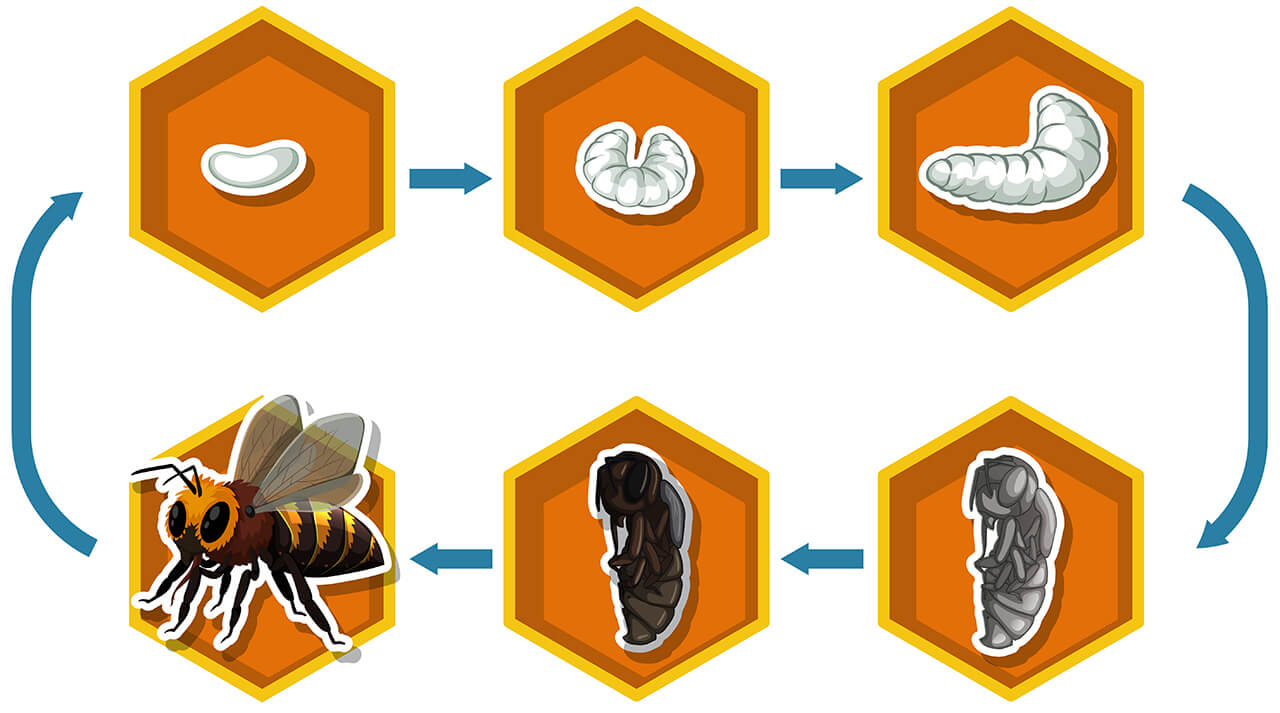
It is important to know that among bees, the development duration is entirely variable from one bee to another. Indeed, for queens, it will take 15 days to go from the egg stage to that of an adult bee. At the same time, a worker bee will take 21 days to go from egg to adult, while the drone will take 24 days.
The Development of a Worker Bee
As mentioned previously, it takes 21 days for a bee egg to transform into a worker bee. For this, it spends 3 days in the egg stage, 10 days in the larval stage, and 8 days in the pupal stage. During the first 8 days, the egg is visible at the bottom of the cell.
It is easily noticed during the first 8 days, and from the 9th day, the cell is capped. In reality, it is sealed by the worker bees following the production of a specific pheromone by the larva. During its development, the worker bee is fed royal jelly for only 3 days.
The Development of a Queen Bee
For a bee egg to become a queen bee, it needs 15 to 16 days of growth. Thus, it spends 3 days in the egg stage, 8 days in the larval stage, and 4 days in the pupal stage. During the queen's growth, the first 6 days are when the egg is visible at the bottom of the cell. This is followed by operculation, and development continues out of sight.
Unlike worker bees, the future queen is fed exclusively royal jelly throughout her development period until adulthood.
The Development of a Drone Bee
Drones are the males of the hive. Their growth is the longest, totaling 24 days. They spend 3 days as an egg and 10 days in the larval stage. After that, they spend 9 days in the pupal stage and reach adulthood.
What is the Lifespan of Bees?
It is well known that the life cycle and lifespan of a bee largely depend on its caste and the environmental temperature. Thus, a worker bee can live between 13 to 38 days in summer. During spring and summer, it can live approximately 30 to 60 days.
However, during winter, a worker bee can live up to 140 days. As for drones, their lifespan also varies greatly depending on the season. Thus, they can live between 21 and 32 days during spring and early summer. When summer arrives, they can live up to 90 days, extending into autumn.
It is important to know that as winter approaches, drones are expelled from the hive by other bees. Generally, very few, if any, drones manage to survive. Meanwhile, a queen can live on average up to 3 years. Her shortest lifespan is one year, and the longest record observed is 8 years.
What Factors Influence Variations in the Bee Development Cycle?
A multitude of factors influence bee development. These include factors such as:
• Race: Depending on the race, bees may have better or worse growth. For instance, African bees show much faster development
• Atmospheric variations and conditions: specifically, atmospheric temperature affects the bee development cycle
• Brood or egg nutrition
• The amount of work to be done within the hive: for bees in a swarm that must take on all responsibilities, it is observed that they tend to live significantly shorter lives than others
There are also other factors that greatly influence, such as caste and bee type.
What is a Bee Fed During Its Development Cycle?
Depending on the caste, bees are fed in exceptional ways. Thus, whether the bee is a worker, queen, or drone, its nutrition varies.
Nutrition of Worker Larvae
Generally, a worker larva receives:
• Secretions from hypopharyngeal glands
• Secretions from mandibular glands
• A small amount of honey
• A small amount of pollen
• Royal jelly
• Water
• Some digestive enzymes.
Nutrition of Queen Larvae
There is a slight difference in the diet of larvae destined to become queens. Thus, these receive:
• Secretions from hypopharyngeal glands
• Secretions from mandibular glands
• A fairly small amount of honey
• Royal jelly in large majority.
Nutrition of Drone Larvae
It is important to know that drone larvae are fed almost in the same way as worker larvae. They receive food similar to that of worker larvae, but with slight variations in composition.
Notably, there is a significant difference in the quantity delivered to these larvae. Given that the drone is quite large, the hive provides it with more food compared to the worker bee.
Nutrition of Adult Worker Bees
When they become adults, worker bees are fed differently. Thus, as adults, they are observed to feed on:
• Pollen: this substance is necessary for the proper development of the bee's glands. Indeed, this is quite crucial during the first 10 days of life. Subsequently, it is no longer truly necessary, unless the brood needs to be fed by older bees
• Honey: this provides energy in the form of sugars to revitalize.
Nutrition of Adult Queen Bees
Regarding adult queens, it is important to know that they are fed by worker bees. In reality, the quantity of food has a great influence on the queen's egg-laying. However, when a queen is isolated, she manages to feed herself with candy and can also survive for several weeks.
Nutrition of Adult Drones
During their first days of adult life, after birth, worker bees are responsible for feeding the drones. They feed them notably with brood food, pollen, and honey.
Subsequently, drones manage to feed themselves with honey, that contained in the cells.
What Activities Does Each Caste Perform During Their Life?
In the world of bees, each caste during its life cycle has its functions to perform.
The Worker Caste and Its Activities
In the world of bees, a worker bee is capable of performing most of the tasks necessary for the colony's evolution. However, it possesses a behavioral repertoire that varies depending on the worker's age and the specific needs of the colony at a given time.
After birth, the worker bee takes care of the inside of the hive for the first 20 days, after which she undertakes outdoor tasks. Among bees, worker bees constitute the most numerous caste. There are several sub-castes, each destined to play a very specific role.
Thus, among the ranks of worker bees, we easily notice:
• The Nurse Bee: primarily responsible for feeding the larvae and the entire hive community
• The Builder Bee: responsible for all activities related to designing and repairing hive defects
• The Receiver Bee: the one who welcomes foraging bees after their quest and unloads them. She collects the foragers' bounty and sends it for processing.
• The Ventilator Bee: these are worker bees that beat their wings to ventilate the hive, circulate air, and ensure good aeration
• The Guard Bee: her role is to guard the hive and only allow colony bees to enter. This helps them prevent potential looting of their reserves
• The Forager Bee: they search for pollen and nectar for the hive, participating in the work within the hive
The Queen Caste and Its Activities
It is important to know that a queen bee has a morphology well-adapted to perform her functions. Indeed, the queen must ensure egg-laying and regulate colony activities through pheromone secretion. More precisely, the queen is equipped with a practically smooth stinger.
Thanks to this bodily component, she can sting her rivals without losing her stinger. In the queen, the abdomen is a particularly well-developed part. It can even reach up to twice the size of a worker bee's. Within this abdomen, there are notably 2 hypertrophied ovaries and a spermatheca.
In reality, the spermatheca is the container that receives spermatozoa from different males during mating. Once received, it stores them throughout the queen's life. This is what allows for both fertilized and unfertilized eggs, as the release of spermatozoa onto an egg makes it fertilized.
In the queen, pheromone secretion is ensured by several glands. It is with these substances that she manages to induce specific behaviors in worker bees and simultaneously modify their physiology.
Finally, the queen is an entity devoid of leg structures that would allow her to perform tasks such as pollen collection. She has nothing that would enable this activity and also does not possess wax glands. The queen is therefore incapable of secreting wax.
The Drone Caste and Its Activities
Drones are known as the males of the colony. Their primary role is to fertilize the queen, and after that, they no longer hold much value. This is why, after a certain period, they are expelled from the hive and left to fend for themselves. However, males can also engage in pollen collection for the benefit of the hive.
In Conclusion
It is important to remember that the world of bees is quite vast and rich. Indeed, the bee development cycle is significantly influenced by numerous conditions.
Nevertheless, caste remains the primary basic criterion for variations in the bee development cycle.
Thus, whether a bee is a worker, queen, or drone, it will spend different numbers of days to transition from egg to larva, from larva to pupa, and then to adulthood.
Once formed, bees immediately get to work, and each is actively engaged in the effective development of the colony.